
In February 2019 my father was diagnosed with leukemia.
Back then my parents lived in Israel and when I visited them in March, thanks to the exceptional Israeli oncology treatment, my Dad looked like he was going to be well in just a few months.
I was quite lost at the time. My job seemed to be a dead end of a career, I was nowhere near the track I wanted to be in, I didn’t know what to do and I lost sight of what I wanted in life.
My Dad told me I was afraid of being myself.
“Go and be yourself,” he said the day before I left.
He died a month later.
You would think that hearing the “be yourself” encouragement from my Dad on what turned out to be his deathbed would ring the great cathartic doorbell in my head. That after a makeover worth of a Hollywood movie sequence I would be proud to say that I became myself and never was anyone else again.
I wish.
The truth is that in addition to the sulking grief, I now had to face an uncomfortable question that I assumed I had an answer to all along.
WHO AM I?
The book I will deep dive into in the next 3 weeks does not give an answer. But it makes you look for one and gives you some tools to find it.
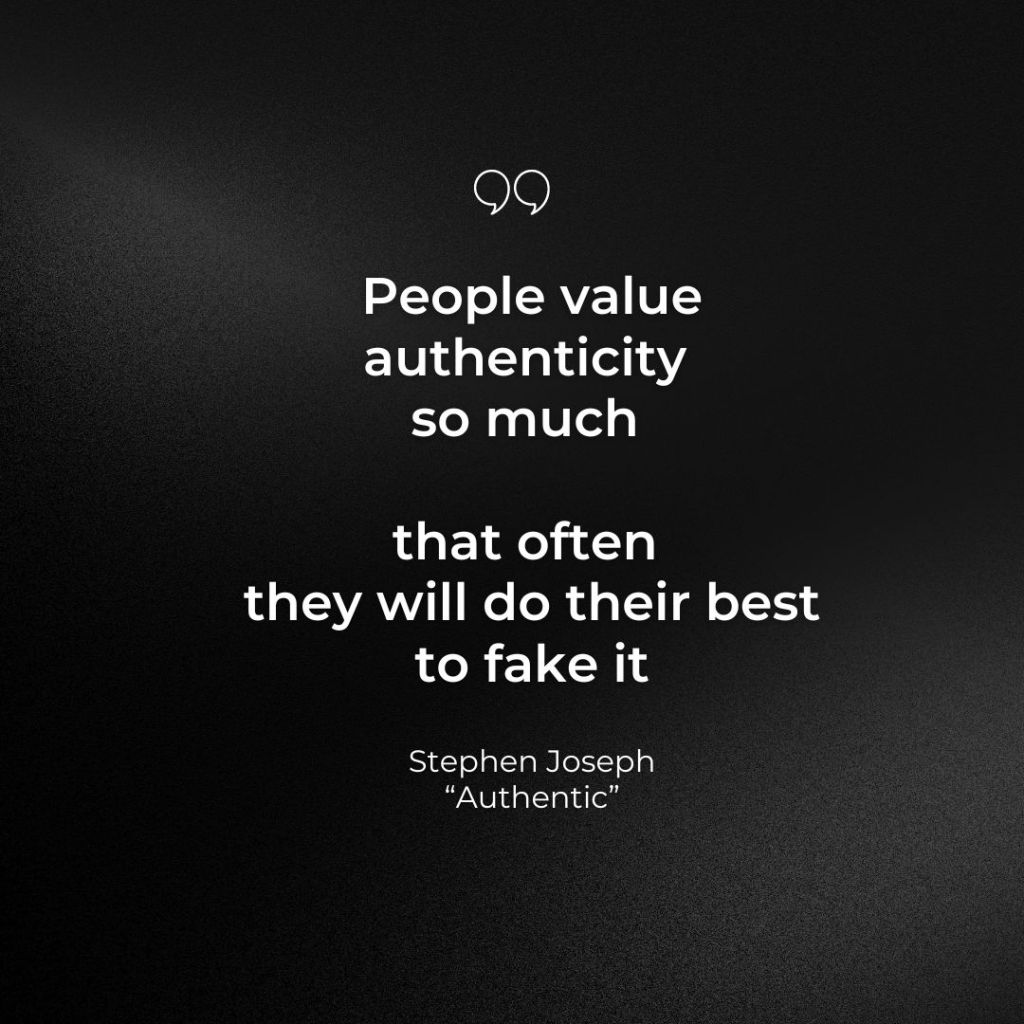
There are many speculations on what it means and what it takes to be true to oneself.
The author of Authentic: How To Be Yourself & Why It Matters Stephen Joseph (PhD, leading expert on positive psychology, college professor) quotes Carl Rogers – one of the most prominent psychologists of the XX century:
For Rogers, authenticity meant being the author of one’s own life.
I love this definition – it simultaneously grants agency to a human being and also encourages creativity and resourcefulness – to me, this is the very definition of the free will.
So how can we become the author’s of our own lives?
The formula of authentic living
Joseph breaks authenticity into 3 interconnected elements:
- Know Yourself
It strikes me how often we hear the (well-meaning) advice to be ourselves preceded by a very light-hearted “just”: “Nervous before this call?” – “just be yourself!” – as if it was a mere formality!
But as I learned back in 2019 – finding who you are is not an easy journey.
In fact, it takes your entire life. You change, people around you change, world changes – not only you refine your understanding of self, you actually start reevaluating what you thought you knew before. This is truly a journey without a destination and if you think you know yourself already, you probably aren’t giving yourself enough credit.
Authentic people […] are able to listen to their inner voice – their gut – and they can understand the complexities of their feelings and hear their own inner wisdom.
2. Own Yourself
Authentic people take responsibility for their choices in life. […] They know the boundaries of their responsibilities and those of others. They own themselves and they expect others to take their own responsibility.
Owning yourself means setting and respecting boundaries and taking responsibility for your actions.
And (as Joseph himself emphasizes) responsibility does not equate blame.
Feeling of guilt is a powerful one but it does not empower us.
In a way (and this is my personal opinion here), it prevents us from assuming the consequences of our actions as if feeling remorse counts as atonement (“look, I am feeling guilty, I am suffering – is this not enough?”).
But assuming responsibility for our actions makes us powerful. It gives us agency.
Consequently, it also prompts us to be more conscious about our choices and decisions.
And isn’t this a great way to become the author of our own life?
3. Be Yourself
Interestingly, this part goes last.
The very word ‘authentic’ is derived from the Greek word ‘authentikos’, meaning to ‘act in one’s own authority’.
But as we saw above, first you need to understand who you are and what is your authority (boundaries and responsibility) so you can truly act on your own behalf.

Why is this so damn hard?
Who wouldn’t want to be an author of their own lives?
After all, who else should we be?
Joseph quotes Abraham Maslow who said –
I think of the self-actualizing man not as an ordinary man with something added, but rather as the ordinary man with nothing taken away.
So what happens to “an ordinary man” so he becomes unauthentic and stops moving towards self-actualization (i.e. becoming everything he is capable of becoming)?
1. Our picture of self becomes distorted.
Through our interactions with others we develop our sense of self. Particularly important are those interactions that are evaluative in some way. Through these more evaluative interactions, our picture of ourselves may become distorted.
2. We develop conditions of worth (I am worthy because I am nice / smart / pretty / do what pleases people / never ask for help / never complain / never argue / etc.).
‘Conditions of worth’: the rules we learn in childhood when the love we get is conditional. […] Conditions of worth become the base for the unforgiving voices in our head that constantly criticize us.
3. “We distort, transform and falsify reality as a defense mechanism”.
Joseph has an entire chapter on the defense mechanisms ranging from denial (“extreme form of self-protection”) to defenses that distort reality (like projection or disassociation) to those that can actually be useful (like humor or intellectualization – when we use thinking to override impulses). While some defense mechanisms can be useful –
… in the long run, the continual use of defenses will lead to problems and most of all them will prevent us from the joy and freedom of living an authentic life.
I would also add here that Being Yourself requires strength of character.
And I don’t think that this strength is just about being able to stand up for yourself or hold your ground in a heated conversation.
I think it all starts with having the bravery to look within yourself and see who you are.
Unless we are clinically depressed, we have a rather positive image of ourselves. But it takes some sort of bravery to look a bit deeper and confront some shadows within ourselves. It might be scary what we find in there.
- What if I actually want this promotion because otherwise my father will think I am a failure?
- What if I push my kids too hard not because I want them to succeed but actually because I want to be a parent of successful kids?
- What if I don’t actually want this well-paid job and this high title?
- What if I am not as good of a person as I thought I was?
This does go deep, doesn’t it?
The good part though is that once we are aware of our demons, we can deal with them. And as a bonus point, once we get them into light, we might often discover that they are actually not as big as they seemed in the darkness of our minds.
But why does it matter?
A considerable amount of time and money had been spent over the years documenting the various ways in which people suffer psychologically, but nowhere near the same effort had gone into understanding what makes life worth living.

Joseph cites multiple research studies proving that authentic people are:
- Happier
- Healthier
- Grittier
- More virtuous
- More realistic
They:
- Play to their strengths
- Have more meaning in their lives
- Cope better with stress
- Live more harmoniously with others
- Have deeper relationships.
And if this does not convince you of the benefits of authenticity, let me come back to the initial question in the headline of this article: “What will you regret in the end of your life?”
Research by Bronnie Ware, an Australian palliative nurse, found that the most common regret of those about to die was not having had the courage to live a life true to oneself.
Although, it is a bit disheartening to realize that being yourself requires bravery (shouldn’t this be the easiest, most natural way of being?), this truly gives some perspective.
It also reminds me of the training I once attended where we were asked to write a letter to our future selves. Here’s how it goes:
Imagine you have a time machine. Unfortunately, it does not transport people but it does deliver mail.
You can aim as far as you want starting at 5 years from now.
Take 10 minutes and write yourself a thank you note to express gratitude for everything you will have done in the future, say, 10 years from now.
What are you grateful for having done?
How did it help you to become who you want or accomplish what you want to accomplish?
Mine could start like this:
“Dear Iryna,
Thank you for all the blogging you did over these past 10 years. Although there were days you doubted your writing skills or were late on the deadlines, you persisted and now you have shared 100 books and more than 5,000 people are reading your weekly articles – isn’t this wonderful? Thank you so much for all the patience and hard work over these years.”
Write 3-4 paragraphs. Focus on what you are doing now and how the fruits of your present actions will reach you in the future.
Be curious.
Connect with your future self.
What are you grateful for?
Seal your envelope and write the year you are aiming towards. Put it somewhere safe and don’t open until it’s time.
Sorry, I forgot to mention – the time machine is slow so you won’t get your letter until it’s the actual year you were writing to.
But it’s worth it, I promise!
The above exercise allows you to extend a link between today and the day after tomorrow.
- Are you doing the right thing?
- Are you doing it for the right reason?
- What will it take to continue?
…
- And what would you do if you were not afraid?
In the next article, we will look into some exercises to help us to know, own, and be ourselves. Stay tuned to learn more!
Discover more from Knowledge In Action
Subscribe to get the latest posts sent to your email.

 Knowledge In Action