

“Strategy Safari” is “War and Peace” of the Management literature.
Everyone says you should read it to acquire good taste for competent thought and get wiser but when you have time to read it, you are too young to understand it, and when you are finally old enough to understand it, you don’t have time to read it.
Yet this is one of the major books on strategy formation – if not the major one.
It’s been translated into over a dozen languages and is included in the top MBA programs worldwide.
“Strategy Safari” summarizes, analyzes, criticizes, and synthesizes a vast number of publications on strategy formation outlining 10 somewhat distinctive “schools” of strategic thought. It makes sense out of what strategy is, how it is created and implemented, who is that strategist everyone wants or claims to be, what is his/her/their role in the organization, and how it all comes together in the bowl.
- Do you consider The Art of War one of the best books on strategy?
- Do you swear by SWOT analysis?
- Do you think every organization should have an outlined mission and vision to be successful?
- Do you find that “culture eats strategy for breakfast” (I’m talking to you, Mr. Drucker)?
Well, then I’m inviting you to keep an open mind because you will be surprised.
The Elephant of Strategy
It was six men of Indostan
To learning much inclined,
Who went to see the Elephant
(Though all of them were blind)
That each by observation
Might satisfy his mind.

The First approached the Elephant,
And happening to fall
Against his broad and sturdy side,
At once began to brawl:
"God bless me but the Elephant
Is very like a wall."

The Second, feeling of the tusk,
Cried, "Ho! What have we here
So very round and smooth and sharp?
To me 'tis mighty clear
This wonder of an Elephant
Is very like a spear!"
[...]
So oft in theologic wars,
The disputants, I ween,
Rail on in utter ignorance
Of what each other mean,
And prate about an Elephant
Not one of them has seen!
With this charming 2-page poetry, The Blind Men And The Elephant by John Godfrey Saxe, the authors of Strategy Safari: A Guided Tour Through The Wilds Of Strategic Management open their discussion on the massive beast of Strategy.
Like with most concepts in life that became mundane from being over-used, strategy and strategic became omnipresent within the professional profile of anybody who gained enough experience to raise above little details of their work and see a bigger picture.
I am quite guilty of it myself as I put “Strategic Advisor” into my LinkedIn profile (after all, I’ve been supporting senior leaders as a chief of staff). Yet as I was going through Strategy Safari this year, I started seeing this word in a different light and am now redefining my role in supporting an organization.
The word might be the same – the meaning of it is different.

Henry Mintzberg, Bruce Ahlstrand, and Joseph Lampel present the elephant of strategy as a complex system – it grows, evolves, and can never be grasped in its fullness. Many tried to simplify it or reduce to one of its parts and failed – both in theory and practice sending numerous organizations into the abyss.
Ask someone to define strategy and you will likely be told that strategy is a plan, or something equivalent – […] a path to get from here to there. Then ask that person to describe the strategy that his or her own organization or that of a competitor actually pursued over the past five years – not what they intended to do but what they really did. You will find that most people are perfectly happy to answer that question, oblivious to the fact that doing so differs from their very own definition of the term.
5 “P” for Strategy
Strategy Safari opens the discussion on 10 schools of strategic management with a brief overview of what strategy is. They summarize it into 5 keywords:
- Plan – this is the most widely accepted understanding of strategy. Strategy as a plan is intended to move us from point A (now) to point B (future). This aspect describes strategy as looking ahead.
- Pattern – “consistency in behavior over time” is our realized strategy. And sometimes the realized strategies have been intended and planned out. But often they are not. For example, a company might take actions towards diversification one step at a time to test the market and eventually find itself realizing a diversification strategy although it had never been formally acknowledged in its strategic documents.
- Position – this is where you might bring up The Art of War or Michael Porter for this aspect implies locating particular
armiesproducts in particular markets. This is when the strategists look down on the map and mark their strategic position. - Perspective – this aspect explores “an organization’s fundamental way of doing things“. The strategists look up to the grand vision of the company they are a part of.
- Ploy – finally, the strategists need to “maneuver” proactively or reactively to outwit competitors. Diverting attention, spreading rumors, overpromising to the investors – this is a somewhat trickster part of strategic management and makes you think of Game of Thrones but in the corporate setting.

I was in my third year studying management in Ukraine when a family friend asked me to talk to his wife. He recently bought her a lingerie store and she was struggling to gain new clients.
“What’s your target audience?” a wise junior year strategic manager (me) asked.
“I want to sell beautiful lace negligee to young women,” she said nervously. “I went to France and ordered all these garments. But nobody is buying them. Instead, I get all these elderly women who live on the street looking for the comfortable cotton bras.”
“Did you advertise anywhere?”
“We printed some flyers and gave them out in the street but I don’t get the sales I want. I ended up stocking on “comfortable cotton bras” and they are so ugly I can’t imagine displaying them in the window! My store has an elegant French name and interior but I’m selling to all these old wives who want nothing but comfort and complain that I don’t have the big sizes!”
Blatant ageism, lookism, and the overall snobbism aside, this is quite a good illustration of the 5Ps of strategy working against the unfortunate entrepreneur.
This kind lady had a plan. I can’t claim in good faith that it was good but it was a plan. She certainly had a perspective – she had a vision for her boutique and took steps to bring it to reality. She chose a market and positioned herself on the city map quite literally. Then her first customers started to come in and shortly she found herself miles away from her initial vision realizing a strategy of the local underwear store around the block. She was maneuvering getting at least some sales in while trying to hold on to the niche of her initial vision.
I remember telling her to create a business plan and get to understand her market better. If she wanted to continue to target high-end lingerie, she needed a bigger marketing budget and if she didn’t have it, then she had to rethink her current vision and target audience. She didn’t like either option and thus my first-ever attempt at offering consulting services ended and I do not have much information on how she ended up doing.
But I’m sure if she had read Strategy Safari she would have not ended in her situation and, perhaps, would have been more grateful she had any customers at all given her wishful thinking approach to running her business.
Because, all and all, having a well-sought-out strategy is the most important thing ever… Right?
Well…
Dilemmas of Strategy
Any discussion of strategy inevitably ends on a knife-edge. For every advantage associated with strategy, there is an associated drawback or disadvantage.
Strategy Safari describes some of them below:
- “Strategy sets direction”: yes, but if followed too stiffly and in the context of high uncertainty, it can blind the organization from emerging threats or opportunities.
- “Strategy focuses effort”: yes, but if taken too far, it promotes “groupthink” and covers peripheral vision.
- “Strategy defines the organization”: yes, but good luck defining a very large organization while simultaneously preserving its rich complexity and experience.
- “Strategy provides consistency”: yes, but what about creativity that “thrives on inconsistency”? Wouldn’t consistent thinking taken too far become unable to challenge its status quo and thus deny the diversity of thought and ideas (which are indispensable for innovation and continuous learning)?
As with everything in management, there are no straight answers that are 100% right and applicable to all.
Invitation to the Journey
Thus, 10 different approaches to strategic thought presented in Strategy Safari.
- The Design School focuses on strategy conception.
- The Planning School sees strategy as a formal process.
- The Positioning School offers strategy as an analytical process.
- The Entrepreneurial School looks into strategy as a visionary process.
- The Cognitive School studies the mental process of strategy formation.
- The Learning School looks at strategy as an emergent process.
- The Power School focuses on the negotiation aspect.
- The Cultural School dives into the collective aspect.
- The Environmental School investigates the reactive aspect.
- The Configuration School presents strategy formation as a process of transformation.
Each of these perspectives is, in one sense, narrow and overstated. Yet in another sense, each is also interesting and insightful. An elephant may not be a trunk but it certainly has a trunk, and it would be difficult to comprehend elephants without reference to trunks.
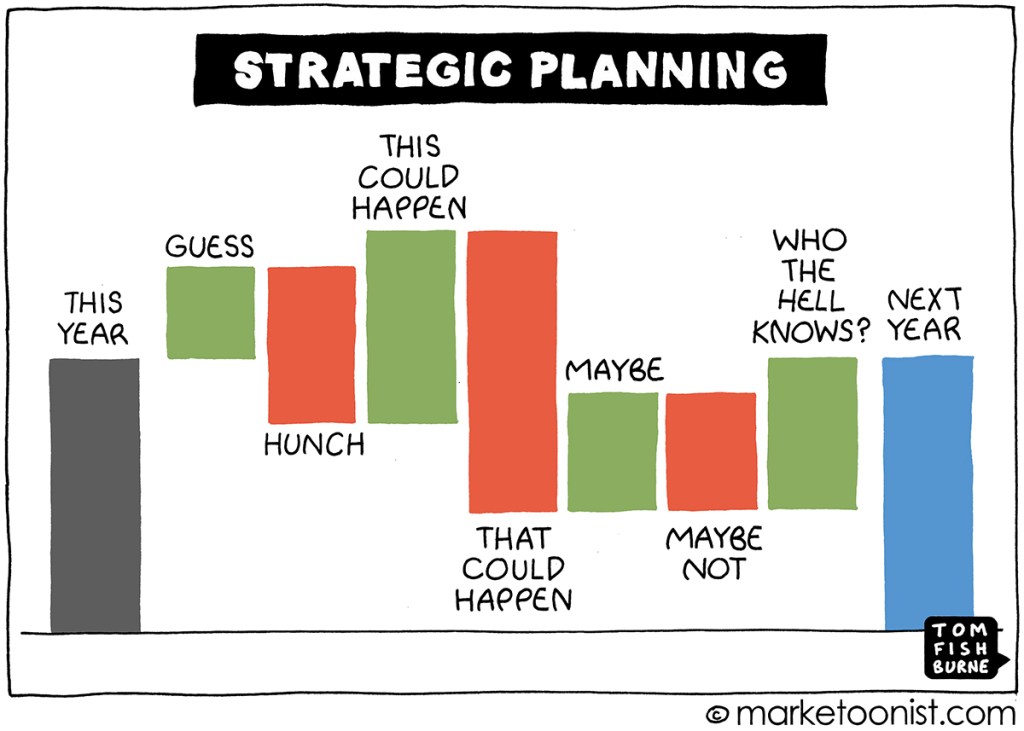
“Culture eats strategy for breakfast“, “execution eats strategy for breakfast“…
Perhaps if strategy was indeed an elephant (which is quite exotic for the first meal of the day), it would be harder to lose it to culture or execution – the concepts that should support the strategy rather than prey on it.
So let’s not find ourselves to be one of the six unfortunate blind men from this article’s opening and explore the entire beast in its might and glory, one school of thought at a time.
Which one are you most curious about?
Next week we will start our safari with the 3 prescriptive schools of Strategic Management: of Design, Planning, and Positioning. Make sure to subscribe to this blog so as not to miss it!
Discover more from Knowledge In Action
Subscribe to get the latest posts sent to your email.

 Knowledge In Action
[…] you recall my very first article on Strategy Safari, the authors compared strategy to an elephant which cannot be described by each […]
LikeLike
[…] Introducing “Strategy Safari”: Are You Sure Strategy Is What You Think It Is? […]
LikeLike