

There are books and there are Books.
In strategic management (and management overall), Strategy Safari is one of those Books that you read once in a lifetime, and everything that you knew, thought you knew, and wish you had known falls into place.
Then you give a sigh of relief… Only to realize that there is so much more out there to learn and to discover.
But this time around you will be prepared!
To give any good book justice in just a few articles is an unreasonable task, so as always, I strongly encourage you to get your own copy and give it some of your time.
With this disclaimer – let’s get into the (more or less) short and sweet review.
What Strategy Safari is about?
Strategy Safari reviews, categorizes, summarizes, analyzes, and systematizes essential views on strategy from Sun Tzu to 1998 (the year the book was published).
These views are not analyzed chronologically but thematically, i.e. based on how strategy formation was described by different authors. For ease of understanding, Strategy Safari calls those themes “schools” and outlines 10 of them.
For instance, Sun Tzu’s The Art Of War falls under the positioning “school”. The authors of this school share the same view of strategy as a position: either on the battlefield against another army (like Sun Tzu) or on the market against competitors (like Michael Porter in the 1980s).
25 years later, Strategy Safari is by no means outdated and its analysis stands strong as ever helping to make sense of the seemingly disjointed ideas and practices of strategic management so prevalent in the field today.
You should read this book if you are…
- A Strategy Consultant: To get the most exhaustive overview of strategic management so you can do the best job possible to serve your clients.
- An Executive: To deeper apprehend your role as a strategic leader and verify the accuracy of the big picture you are getting inside and outside of your organization. Also, to avoid falling for the “next best trend” in strategy making.
- A Business Operations Lead / Chief of Staff: To navigate and help guide the strategy formation within your organization; to translate strategy into operational actions and operational actions into effective strategic pattern.
- Someone interested in strategic management: This book is written by management academics and is recommended for MBA programs. This is a complete course on strategic management in itself.
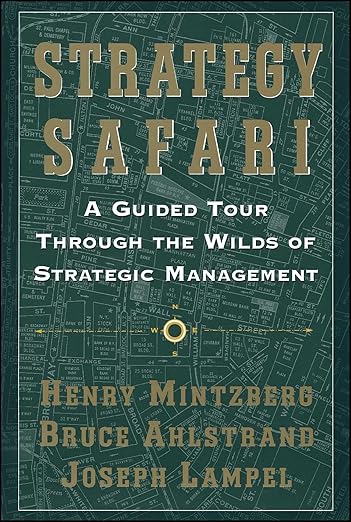
This book –
- Provides the most exhaustive overview of strategy and strategic management.
- Analyzes and critiques some of the most widely accepted thoughts on strategy.
- Gives space to the unorthodox “schools” of strategy (of power, environment, culture).
- Places strategy and strategists in a context.
- Teaches critical thinking when approaching strategy and change management.
- Makes you appreciate strategic management more than ever before.
- Broadens your view.
- Is rich in metaphors.
- Is quite a fun read.
But
- By no means is an easy read.
- You will need to revisit certain paragraphs a few times.
- While ever so relevant, my copy of Strategy Safari (first edition, first published in 1998) would benefit from analysis of the most recent waves of the described “schools” and their application in the post-pandemic world.
This is a book of the school of thought on strategy formation both in publication and in practice.
Key Ideas
I. Elephant Dilemma
- Strategy Safari opens with a poem about six blind men trying to apprehend what an elephant is by touching only one part of the said animal each and trying to extrapolate what they feel or hear onto the entire beast.
- “We are the blind people and strategy formation is our elephant.” For years, best minds – theorists, practitioners, entrepreneurs, consultants, generals, CEOs – extrapolated the aspects of strategy onto the entire concept creating blind spots for themselves and their organizations. At the same time, it would be impossible to describe the concept of strategy without its aspects. So how to approach this dilemma?
II. Book’s Approach
- Strategy Safari introduces 10 “schools of thought”: each school represents a certain point of view on strategy formation, “most of which are reflected in management practice.” The guiding ideas and principles of each school either prescribe how strategy should be developed in theory or describe how it is actually being developed in practice.
- It is important to note that none of these schools are formal. For instance, Michael Porter didn’t make a conscious decision to become a founder of the positioning school of strategy and enroll Sun Tzu in postmortem. Rather the authors of Strategy Safari conducted an exhaustive analysis of all major (and many minor) publications on strategy and based on this analysis offered a breakdown of strategic thought into 10 major categories aka “schools”.
- Taken separately these points of view are both “narrow and overstated” and “interesting and insightful.” This is why Strategy Safari designates each school one chapter to analyze, critique, and put it into context. In the final chapter, the authors provide the overall synthesis of all schools consolidating the “elephant” back into one beast while simultaneously opening the door to more nuances and strategy animals (not every strategy is an elephant, after all).
III. 10 Elephant Parts Schools of Strategy
- The design school claims that strategy originates in the mind of a CEO as a simple yet powerful answer to the opportunities and threats of the environment and the existing strengths and weaknesses of the organization. This strategy is unique and simple enough to be passed on to the entire organization by its creator. This school also gave us the SWOT analysis.
- The planning school sees strategy as a big plan that permeates the entire organization from top to bottom. The CEO should approve it but it’s the planners who play the most important role here.
- The positioning school (hello, Michael Porter and Sun Tzu!) promotes thorough market analysis which will allow to “prescribe” a strategy most suitable for this particular organization. No unique strategies here – only “generic”, well-verified ones (just like strategy positions on the battlefield from The Art Of War).
Want to succeed in business? Ask your consultant about a “generic” strategy that is right for you! - The entrepreneurial school sees strategy as a vision that might or might not be formalized by an entrepreneur.
Want a new strategy? Hire a visionary CEO! - The cognitive school takes its roots in cognitive psychology and questions how the strategy is formed exactly – i.e. what is the thought process that goes into strategy formation? One wing of this school thinks that we form successful strategies if we manage to perceive reality as objectively as we can (eliminating our biases, misconceptions, and subjective interpretations). The other wing claims that we will never see the objective reality to begin with because all we can do is interpret what we manage to perceive. And what is perceived as a threat by one organization might be interpreted as an opportunity by another. Even strengths and weaknesses on our SWOT table become highly subjective depending on the beliefs of our executives.
- The learning school rejects any “prescriptions”. You must test your strengths and weaknesses in action. How do you know what is an opportunity and what is a threat out there? You need to allow strategies to grow like weeds in your
gardenorganization! - The power school sees every worker within the organization pursuing their own self-interests. This creates constant conflicts risking to tear the organization apart. Thus, strategy is a result of constant negotiation and compromise. The environment “out there” becomes a big chess board too with an organization navigating its way among competitors, regulators, consumers, and suppliers using strategy as a ploy.
- The cultural school lies on the complete opposite – it sees strategy as a derivative of the organizational culture which ties all its actors together under a unified vision and shared values. Culture glues all the chess pieces together – sometimes to the chess board itself – so tight that changing strategy becomes impossible due to the “groupthink” and collective resistance to change.
- The environmental school removes any “S” and “W” from your SWOT table because they don’t matter. Only Environment exists and it defines how many strategic choices (if any) your organization has. This is the most unorthodox school of strategic thought, more of a “detour” on the safari than a valid part of an elephant.
- The configuration school says that each point of view on strategy has its merit at its own time and place. This school introduces the notion of organizational lifecycle and sees an organization leaping from one stage to another using elements of each school (aka configuration) depending on the context. Strategy formation is, thus, seen as a process of transformation.
III. Elephant And Other Animals We Will Never See
- The final chapter puts all disjointed pieces together summarizing and juxtaposing the key elements of each school. Each school receives a metaphorical mascot that best describes its key ideas. For instance, a spider is chosen for the design school (“solitary figure so carefully designing its web, strong enough to exploit its distinctive competences”) and a squirrel for the planning school (“gathering and organizing its resources in preparations for the coming months”).
- “Come to think of it, we never did see an elephant,” the authors conclude, alluding to the fact that the beast of strategy they were attempting to break into parts and then consolidate back into one never even showed up. Perhaps, it is impossible to fully comprehend what strategy is, after all.
- Perhaps, there are more animals out there to discover.
- To conclude the book, the authors offer questions and dilemmas that arise on the outlines and at the edges of all schools – “the “whens” and the “wheres”.”
- Some examples include questions like “How elaborate, how nuanced, how comprehensible, how general do we want our strategies to be, when and where?”, “How unique or novel should a good strategy be?”, and “How much… do organizations learn, how easily, and how, when, and where?”
- It’s by answering these questions that we can truly approach our elephant. “We shall never find it, never really see it at all. But we can certainly see it better.”
But the fault, dear Brutus, lies neither in the stars nor in ourselves, but in the process itself. Strategy formation is judgmental designing, intuitive visioning, and emergent learning; it is about transformation as well as perpetuation it must involve individual cognition and social interaction, cooperation as well as conflict; it has to include analyzing before and programming after as well as negotiating during; and all of this must be in response to what can be a demanding environment. Just try to leave any of this out and watch what happens!

Useful Links
If you missed my deep-dive articles:
- Introducing “Strategy Safari”: Are You Sure Strategy Is What You Think It Is?
- Would You Accept A Prescription Of Generic Strategy?
- How Accurate Is Your “Big Picture”?
- Do You Cultivate Your Strategies Like Tomatoes?
- How Much Power Do You (Yes – YOU!) Have Over Strategy?
- Finding Your Next Strategic Configuration
To continue exploring strategy:
- Henry Mintzberg (Strategy Safari co-author) has a website where you can purchase more of his books or read his blog. He also regularly shares some of his articles on his LinkedIn page.
- To purchase Strategy Safari on Amazon: first edition (1998) and second edition (2009).
Oof! This was one of the most rewarding but also one of the toughest books to deep dive into… I don’t know about you, but I’m ready for some time off! And I mean – Time Off: A Practical Guide to Building Your Rest Ethic and Finding Success written by John Fitch & Max Frenzel and illustrated by Mariya Suzuki. Come, join me next Monday. I hope to see you then!
Discover more from Knowledge In Action
Subscribe to get the latest posts sent to your email.

 Knowledge In Action