

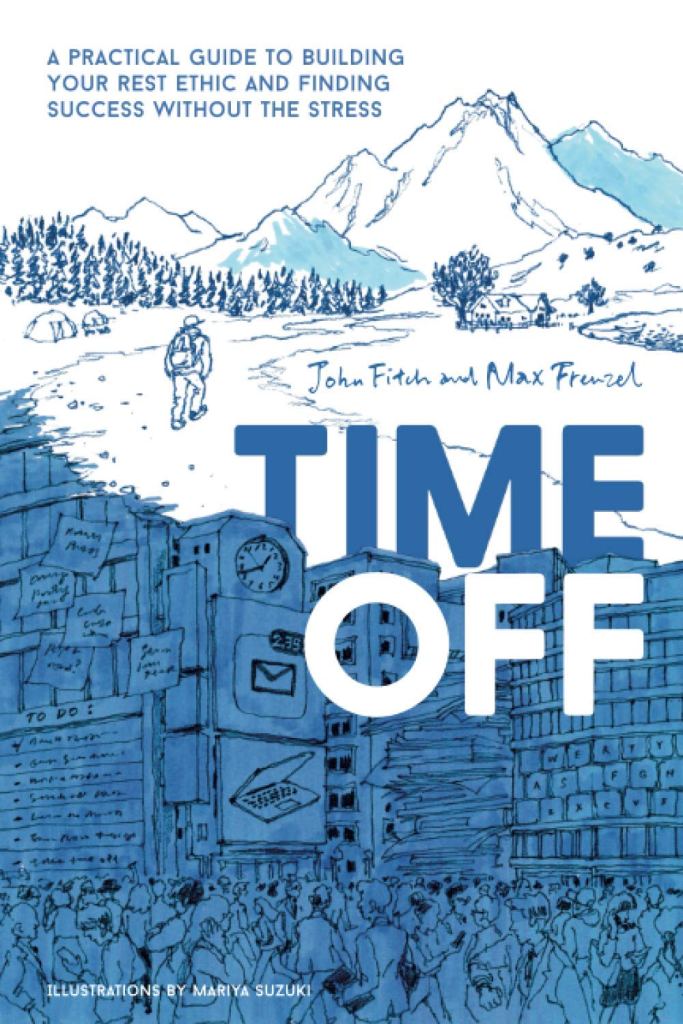
So, should you read Time Off?
I say, yes – but with caution.
This book is beyond useful to shift the mindset from “I’m too busy to take a break” to “I need a break so I can live (and work) better”.
It left its long-lasting mark on me, and I already see some positive changes in the way I am approaching my days.
But its last chapter – The Future Of Work – which I assume was supposed to conclude the book on a high inspirational note – left me uneasy and more thoughtful than hopeful.
So what’s so good about this book and where does it fall short?
Let’s see.
What Went Well?
Time Off is about the practices that keep us from feeling overwhelmed and overworked; practices that allow us to live happier, richer, more fulfilled lives; practices that, somewhat counterintuitively (although we hope that it will seem very obvious by the end of this book), allow us to be our most productive and creative selves.”
Time Off is a well-structured book that covers all (or most) aspects of time off.
It’s not just about rest (or rest ethic, as many reviewers suggest) – it’s about creating space and time for creativity, reflection, solitude, playfulness, and… work.
Yes, work – because today more than ever technology and busy over-cluttered schedules make it progressively hard for us to sit down and focus on a big task that requires time and deep thinking.
Excessive meetings devour our time, decisions are made on the go, and work and life blend like scarlet and cobalt paints: we are never fully at work and we are never fully out of it – everything is a shade of purple, and even on our happiest days we are feeling a little bit blue.

In that sense, Time Off is an exceptional guide to our creative and resourceful selves.
The book reminds us why we are so busy these days, destigmatizes leisure time, shares stories of people who found a way to carve out time off to achieve great things (and just be themselves), gives practical (and very doable) recommendations, and overall opens the doors to self-reflection and discovery.
I shared some useful practices and techniques from this book in my previous articles, but Time Off has so many more to offer. I cannot recommend it enough for anyone who struggles to keep their head above the water, feels burnt out, or lost their “spark”.
But as mind-opening as it is, Time Off isn’t deprived of a certain narrowness of view.
Overly Optimistic View Of The Future
Time Off claims that with the development of AI, many routine “busy work” jobs will be transitioned to machines while humans will have more time and space to do what humans are supposed to be doing: inventing, exploring, researching, strategizing, leading, and creating. Instead of specialized skills, we will have more generalized capabilities that will further nurture our innately human ability to connect the dots, utilize systems thinking, and apply our intuition.
AI could do the work meant for machines. And… we will soon see machine learning and robotics create tens of trillions of dollars of wealth for mankind.”
AI expert and venture capitalist Kai-Fu Lee, quoted in the book adds that –
Routine tasks ‘are not what makes us human. What makes us human is the capacity to love’.”
Both Time Off authors work on developing AI to advance technological progress which should liberate human potential from fruitless busyness and burnout.
It’s a noble cause but it comes with a caveat.
Both John and Max are a part of the tech industry which has been in bloom for the past few decades. Both are highly paid professionals who can afford breaks and sabbaticals. Both live in the first world (US/UK/Japan) that has a strong need for their skills and experience. Both had been able to work remotely before it became mainstream.
It’s easier to see the future in a brighter light when you come from a certain background and work on a cause that you strongly believe in.
But looking at it a bit more skeptically, I couldn’t help but wonder:
- How exactly those “tens of trillions of dollars of wealth for mankind” will be used by mankind?
- And how our “human capacity to love” will translate into bills paid right now?

Photo by Johnny Africa on Unsplash
Technology is already pushing some jobs into the abyss. But those who stay safe from the cuts don’t seem to get more free time – they are just getting busier and more stressed out because the work ends up redistributed among fewer people. And those who are left behind (call center workers, copy writers, hospitality personnel) can’t benefit much from their newly acquired “time off” as they tap into their savings, scramble for connections, and face very real homelessness.
So far it seems like technology will not be the tide that lifts all the boats but rather an earthquake that will elevate some lands and sink others while widening the already existing gaps in revenue, education, network, and opportunities.
In other words, advancing technology will certainly open more opportunities for some of us but to gain a massive shift depicted in Time Off we need to do more than reading this book and advancing AI.
The shift towards time off and noble leisure requires a systemic (if not seismic) shift in corporate cultures.
Yes, we need to rethink our capabilities and how to best apply our very humanness. Yes, it is clear that the world is moving toward shorter working hours and more time off. But before we have achieved the heaven of noble leisure, we need to envision our way there, raise awareness of the risks it entails, support those in transition, and approach technology progress responsibly.

Finally, to bring back the culture of noble leisure and unleash our human creativity we need to address the most important of all questions: Why?
Why spend time on leisure when we so often run towards busyness to escape ourselves?
Why strive to be creative if we have nothing to create?
Why be more productive if our work has no meaning?
What is this all for?
We need to intentionally fill the newly created free time with meaning, or we risk quickly undoing our positive changes again and falling back to mindless technology use to avoid confronting the void.”
Will leisure give us meaning and all the answers once we carve out time for it?
Or should we find meaning and then structure our leisure around it?
I guess, everyone needs to find out for themselves.
In Conclusion
Time Off is an easy, inspirational, and practical read that will give you plenty of techniques and examples to infuse your days with life and time off. But how to find meaning for and in this newly acquired freedom – this will be the question for you to answer on your own terms.
This book exists because we are extremely optimistic that our culture can find its way back to noble leisure… But we want to reiterate… that we’re not advocating a culture of laziness, sloth, or stagnation. It is a culture in which productivity and the joy of life go hand in hand, a culture of productivity in a much broader sense, rather than just economic output. A culture of creative, scientific, spiritual, and humanitarian progress. A culture of noble leisure.”

Useful Links
If you missed my deep-dive articles:
- Are You Living Like It’s “Milk O’clock”?
- How Long Do You Let Your Ideas To Incubate?
- Concluding “Time Off”: Be A Lantern
To continue exploring time off and noble leisure:
- Max Frenzel’s website: https://maxfrenzel.com/
- Deloitte US podcast: John Fitch & Max Frenzel on how to rest as hard as you work
- To help with your sleep: The Neuroscience Behind Fixing Your Sleep Schedule
- To purchase Time Off on Amazon: link
Next week, we are going to dive into the latest book by Adam Grant – Hidden Potential: The Science Of Achieving Greater Things. We’ll talk soon!
Discover more from Knowledge In Action
Subscribe to get the latest posts sent to your email.

 Knowledge In Action
[…] wasn’t on the list, but I would also highly recommend reading Time Off I reviewed earlier. Some of the techniques used in that book would give you time and space to find […]
LikeLike