

I read this book so you don’t have to!
The Present: The Gift for Changing Times by Spencer Johnson, MD can be largely summarized by the quote, mostly known from Kung Fu Panda and often attributed to Eleanor Roosevelt: “Yesterday is history, tomorrow is a mystery, and today is a gift. That’s why they call it the present”.
In this review/deep dive, I will attempt to look beyond this book’s clichéd ideas and quite a utilitarian approach to the present moment. Because if I’m being honest, this book, despite its on-the-nose story, made me think and reflect on the way I am living in the present and am approaching my past. And perhaps exactly because of its shallowness, it nudged me to look for more answers elsewhere, and this is also something I will share with you today.
With this in mind, let’s take a closer look.
A Story Within A Story

Two former co-workers, Liz and Bill, are having lunch together. After a recent promotion, Liz is under a lot of pressure so she seeks advice from Bill, who is very successful and is visibly enjoying his life.
Bill shares with Liz what he calls a “practical parable,” The Story Of The Present—a story about a young man who looked for success in life and was very disappointed after he hadn’t received the promotion he’d so desired.
The young man comes to the old man, the neighbor he loved spending time with when he was little and who once told him about The Present—the gift that, once received, makes you enjoy things more and do things better, and is “the only thing that doesn’t change in changing times.”
Over the next few years, the old man mentors the young man and teaches him more about The Present, which turns out to be… the present moment (I’m sure you didn’t expect that).
Eventually, just as promised, the young man grows happy and successful in his personal and professional life, finds his focus and the meaning of life, and becomes an old man himself, passing on the life lessons he’d learned to his new neighbor—a little girl. Those lessons are outlined in a VERY LARGE FONT throughout the 73-page book and can be best summarized by the lesson outlined on page 58:
…
Anytime You Are
Unhappy In The Present
And Want to Enjoy
The Present More
It Is Time For You To
Learn From The Past
Or To Help Create
The Future.”
— Spencer Johnson, MD, The Present
Liz diligently takes a lot of notes, thanks Bill, and moves on with her life. Sometime later, they meet again, and Liz, who is no longer tired or anxious, shares with Bill how her life has changed after she started applying the lessons from The Present story, and how she helped to change the lives of her two co-workers and her husband by sharing the Present with them.
The End
The Good, The Bad, And The Overpriced
The Present caught my attention because I was going through a lot of change this year and appreciated re-visiting Who Moved My Cheese? by the same author.
Reading The Present, however, disappointed me quite a bit.
Don’t get me wrong: there are some good lessons out there and the way the young man unfolds them is somewhat relatable.
But the part with Bill and Liz—when Liz pretty much begs Bill to tell the story and then reports back on all the different ways it worked out for the people around her and herself—is very clumsy and irritating at best. I understand that this part was intended to unobtrusively share with the readers how they can interpret the lessons from the story and apply them to their lives. Still, it was executed in such a non-subtle way that I couldn’t shake off the feeling that The Present forces you into some sort of a success-story MLM scheme.
It doesn’t help that for a story that markets itself as inspiring, The Present offers quite a superficial view of the present and its purpose. The words “success”, “effective”, and “effectiveness” are sprinkled all over the text as if the only purpose of the present is to meet objectives and expectations. The quotes below perfectly illustrate this.
When people are happier and more effective—at work and at home, it’s better for everybody.”—The Present
Then I ask myself what my Purpose is right now. Is it to make my sales quota? Or is it to serve my customer’s needs?”—The Present
You know, if I had to think of my Purpose with a capital “P”, I would try to look beyond customer service.
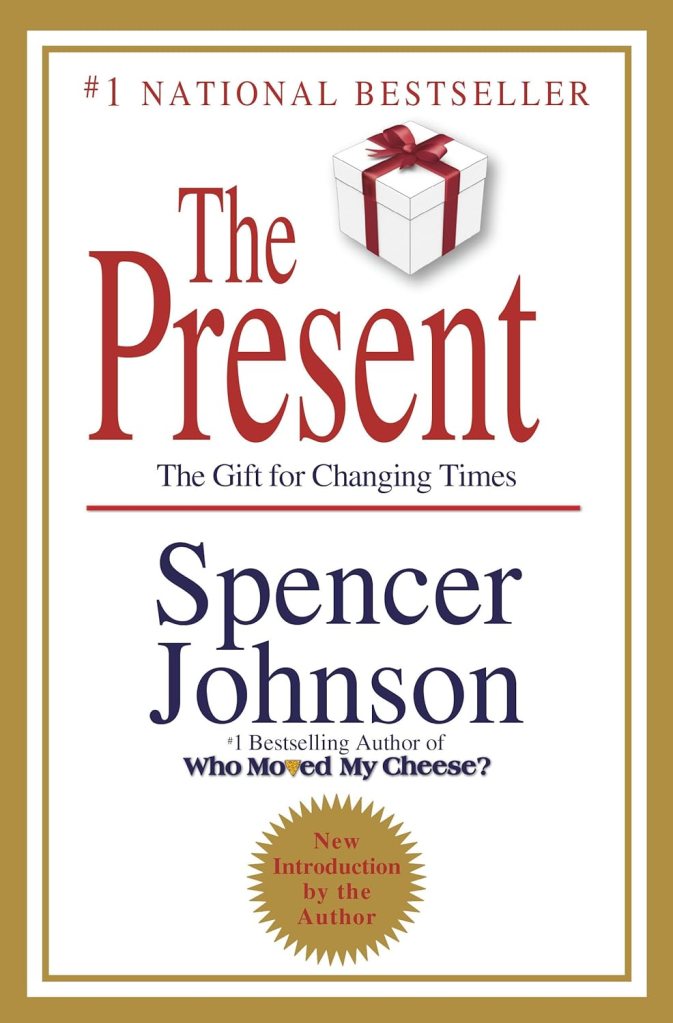
All and all, The Present could have been easily seen as a lovely little reminder about the importance of staying focused in the present moment and letting go of the past. But adding a price tag of $22 USD makes it a brilliant yet cheap attempt to milk a 1-page story (it becomes even more obvious when you find out that The Present is an updated version of The Precious Present, the book originally published in 1984 that didn’t contain Liz and Bill’s tedious lunch conversations).
Looking For Answers Elsewhere
There is nothing wrong with a practical approach to life. After all, we all need to bring food to our tables and meet the objectives of the business or non-profit we are a part of.
We all want different things in life and just as The Present points out, success means different things for different people. But there is a reason why human beings start feeling inexplicable emptiness if they remain driven by effectiveness alone. Some things in life cannot be measured. Are you a successful husband? Are you an efficient girlfriend? Would you like your kids to remember you as an effective parent (whatever that means)?
Sooner or later, we get the urge to go beyond sheer practicality and seek a deeper understanding of self to discover our purpose in life.
In this regard, The Present is comparable to a quick injection—a steroid boost that can help you find motivation for a few days or weeks after you read it. But you cannot live off continuous steroid injections. At some point, you need to find a medicine that will work long-term. This is why I strongly recommend Stephen Joseph’s Authentic, or works of Carl Rogers and Viktor E. Frankl, whose books provide a life-changing therapy that can help you find the meaning that will stay with you for years to come.
I also recommend a 15-minute video from Alok Kanojia, an American therapist known best as Dr K that I am embedding below. At the 07:24-min mark, he gives a passionate (beware of some f-bombs) speech about using today to leave things in a better shape for tomorrow-you.
Ever since I watched this video, I started approaching my days differently.
There is something very powerful in looking at your day as a way to help out your future self. Yes, I can do this tomorrow. But if I do this today, the life of tomorrow-me will be a little bit easier.
So far this is the best way to express love and care for self that I am aware of.
In Conclusion
The Present is a sweet little story about the importance of the present moment. It is not as profound as it wants to be but it is practical and offers a dose of inspiration. While I don’t think The Present is an essential reading, I can see it being useful to achieve a short-term goal: boosting your team’s morale or finding focus amidst changes.
For the long-term changes and finding a deeper meaning of “The Present”, there are many other authors who explore more complex ideas, look into the heart of the matter, and aim to uplift and transform your life—not augment its effectiveness.
Useful Links
- Yes To Life: In Spite Of Everything by Viktor E. Frankl
- Four Thousand Weeks – Time Management For Mortals by Oliver Burkeman (I’ll be reviewing it in January).
- To Purchase The Present on Amazon: link
It is only when you Work and Live with Purpose and respond to what’s important about The Present, Past and Future, that it all has meaning.”—The Present
—And this is a perfect segue into the next book we will be deep diving into over the next few weeks—Start With Why by Simon Sinek. See you next Monday!
Discover more from Knowledge In Action
Subscribe to get the latest posts sent to your email.

 Knowledge In Action