
To all my fellow Business Operations folks reading this, do you remember that one time when your boss told you, “This isn’t working, we must drastically change our approach” only to hear out your detailed plan a week later and claim that the organization was not ready for it?
They say they want it but they don’t
In my experience as a psychotherapist I continually wrestle with a fundamental paradox: Clients come to therapy seemingly wanting to change but then spend most of their time resisting it.
Company managers are not much different.
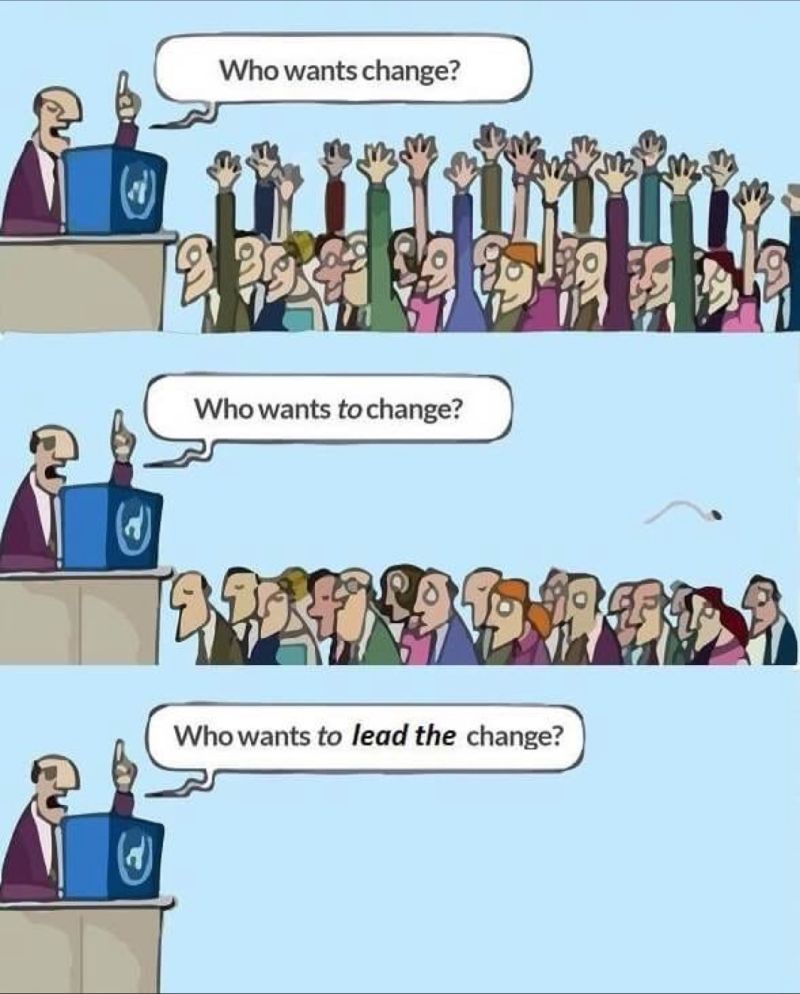
Partially, this can be attributed to the fact that change always meets resistance both above and below so leaders are trying to avoid the hassle if they can (they already have enough to deal with). This is why even if they are receptive to hearing ideas, when it comes to implementation, they will find dozens of excuses and objections not to push them through.
Another, more fundamental reason, is that admitting the necessity of change requires looking honestly at the reasons it is required to begin with. And those reasons often trace back to those in charge.
It might be hard to admit that the methods we used before either directly caused the current undesirable state or are not working anymore thus making things worse in the future.
When Kite was acquired by Gilead Sciences, it had to quickly mature from a start-up into a corporation and scale accordingly. I have witnessed several managers, who otherwise had the skillset necessary for a small innovative company, struggle to champion or initiate changes that were required for a more mature organization.
Big changes are easier
Farson calls it “the case against gradualism”.
He quotes physician Dean Ornish who in arguing for a strict diet regimen said that “It is easier to make big changes rather than small ones because the benefits are so much more dramatic and they occur so much more quickly”.
As a Business Operations professional who witnessed and directly managed organizational changes and as a parent who tried a gradual approach to sleep train my child, I have an additional argument: a really big change seems so overwhelmingly massive, it is really hard to fight it at once. Instead, people shift their focus on the details of the implementation process rather than attacking the actual subject of change (“this is moving too quickly”, “I don’t have enough information”, “I don’t understand what I need to do”).
And vice versa, the smaller the changes are, the more they are objected as unnecessary and / or not worth the effort because it is so easy to pick them apart.

This is an important factor in securing buy-in: bold moves are respected and if you manage to make a compelling case with the emphasis on quick benefits, you might succeed to push through a significant project. And if you attempt to take baby steps, you have more chances to fail.
This is also a good argument in favor of root cause analysis. Getting to the root of the problem might reveal the need for massive changes, but knowing that a big change is easier than a small one, you might as well take an action to fix many little problems in one move.
Everything We Try Works, and Nothing Works
Or, rather, everything we try works at first but then stops.
Farson brings up his consulting experience when he witnessed some consultants who he considered not sufficiently trained or even unethical to work with a client, and to his surprise they were as successful as the consultants he most respected.
One of the possible reasons could be the novelty of the techniques a Consultant brings in – they generate optimism for the new adepts (it’s exciting to try out something new). When a consultant is actually good and knowledgeable, this enthusiasm helps to drive the change and push it through. When a consultant is bad, the same enthusiasm can mask the inefficiency of the service provided.
But what Farson uncovers here and what constitutes the actual paradox is “the unsettling fact that any changes introduced by consultants will soon fade and disappear, leaving almost no trace of their having ever been instituted”.
I worked with a few consulting companies over the years but one particular example illustrates this paradox best.
A Big Three Consultant was invited to optimize the operating model of the company I worked for and reduce the number of multi-layered decision-making bodies (committees, councils, etc.). This massive project of several concurrent workstreams lasted about a year and cost us over $30M. It produced great ideas and many of them were initially implemented.
However, a year later, most of the changes were either reworked (for example, some departments underwent restructuring the very next year creating new decision-making bodies) or completely disappeared (for instance, all the proposed improvements to the budget cycle were scraped off when the Headquarters pushed down a new budgeting process making the proposed changes irrelevant).
So, is the conclusion then to never use consulting services?
Of course not. In fact, professional consultants might often be the only guiding force that can quickly and honestly identify the problems the company is facing and challenge the status quo pushing the Leadership to admit the issues and take reasonable steps to fix them.
The conclusion is that –
There are no quick fixes.
That’s it. The real change requires discipline and consistency. If you really – REALLY want to change something, you need to stay on task. And in the world where even a CEO often has a 3-year tenure, it’s all too tempting to jump into a new technique (that will work but only for so long) rather than attempt to look at the problems systemically and holistically ensuring organizational longevity.

So let’s make a good plan then?
Continuing to challenge everything we think we know, Management of the Absurd offers the following thoughts on why planning out a change might not prove to be an effective way to making it happen:
- It is hard to see from the inside what changes the organization desperately needs. The obvious “you don’t know what you do not know” is coupled with the equally evident fact that it is really hard to break inertia on organizational processes and commitments. This is another reason why having experienced consultants or Business Operations teams on board is so helpful as they can ensure independent evaluation of the corporate goals and programs/projects supporting them to ensure planning is supporting the necessary changes, not avoiding it.
- Team or department in charge of planning might be isolated from the rest of the company: either from the top (unaware of the top-management needs and concerns), the bottom (located deeply in the Corporate having no connection to the shop-floor / client site / lab teams and their challenges), or (the worst case scenario) – from both. In this case, plans are either not strategic enough (isolation from the top) or fail to be executed (isolation from the bottom).
- Planning is highly vulnerable to “politics”. In his book Strategy Safari (which, by the way, I will be reviewing in May), Henry Mintzberg described the Power School of Strategy which among other claims states that no strategy can ever be carried out at 100% because of the purely political reasons within the organization.
According to Farson, plans cannot fully predict or accommodate political pressures that the managers in charge of the implementation will inevitably face. Those can come from the outside (customers, vendors, unions, etc.) and even more so – from the inside. Failing programs or toxic managers cost companies millions of dollars every year, however, keep being written into the annual plans because of the human relationships flourishing throughout the organization, partially or totally invisible on the organizational charts. - Finally, to carry out to a T any plan, even the best one, requires so much control that it either a. creates a culture that cripples spontaneity and creativity in approaching any problem or b. is plainly impossible in a non-authoritarian environment.
Does it mean we should stop planning? No, and here is why:
Planning may not be effective at assessing the future, but it can be a good way to assess the present. It also indicates trade-offs that may be necessary, sets boundaries so that possibilities can be carefully assessed, simulates plausible scenarios, integrates ideas, and forces people to think about consequences. […] The process, not the product is what is important.
Do you agree with Richard Farson?
To conclude our journey with Management of the Absurd, in the next article we will take a somewhat philosophical turn and will look into the aesthetics of leadership – the role of wisdom, unlearning, and power of love.
Discover more from Knowledge In Action
Subscribe to get the latest posts sent to your email.


[…] My article on the hardship of change – Deep Dive into “Management Of The Absurd” […]
LikeLike