

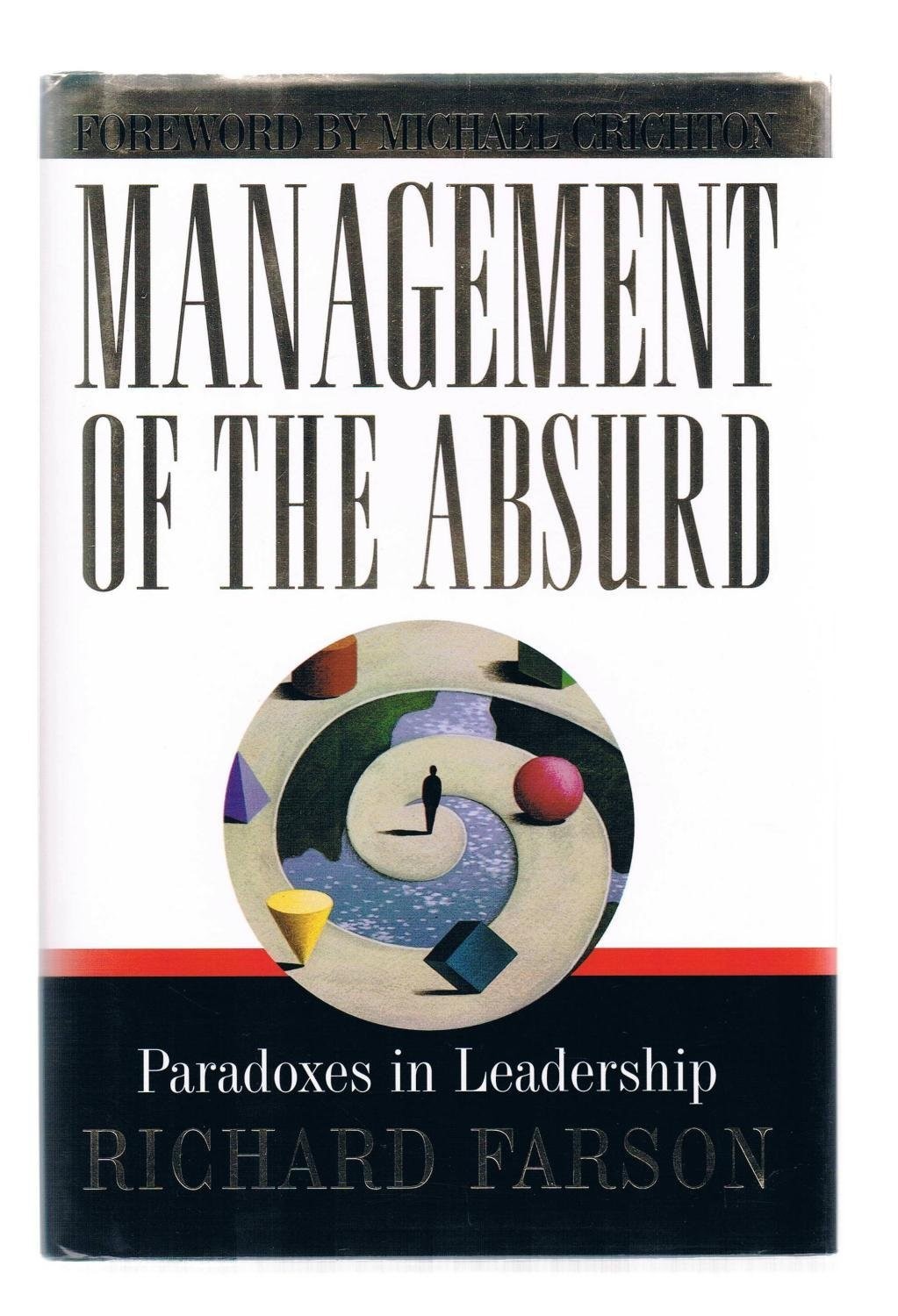
Just as the title suggests, this book is about paradoxes in leadership.
A paradox is a “seemingly absurd or self-contradictory statement or proposition that when investigated or explained may prove to be well founded or true”.
Throughout his book, Richard Farson gives various examples of dilemmas leaders and managers face due to the paradoxical nature of human relations.
You should read this book if you are –
- a People Leader: it will make you see your role in a new light and re-examine your thought process and decision making.
- a Chief of Staff: it will give you a better context of the challenges your leader is facing so you can offer better insights, advisory, and solutions.
- a PMO Lead / Project Manager / Change Manager: it will give you new ideas on what changes are actually needed within your organization, what constitutes political climate, and how to support your organization through change.
This book –
- Challenges the way you think
- Makes you question what you think you know
- Teaches you to see the “invisible”
- Gives you food for thought
- Offers you humanistic view on leadership
But…
- Lacks the “so what?” conclusions
- Does not contain a lot of research examples (illustrations of key ideas are coming from the author’s [vast] experience or well-known events such as the Civil Rights movement)
- Does not give you definitive answers nor solutions
- Does not tell you what to do with the ideas you just read
It is a book of ideas, observations, and lessons learned, not a book of management techniques.
Key Ideas:
I. Predicaments vs. Problems:
- Human relations are not rational and thus there is no “how-to-do-it formula” nor management technique that can teach you how to “master” leadership – it is simply impossible.
- Leadership is about managing dilemmas. This entails coping with ambiguity, recognizing the coexistence of opposites, and applying non-traditional thinking.
- As you go up the ladder, the scale of dilemmas increases. Instead of solving the problems you will find yourself coping with predicaments.
- Coping with predicaments requires from executives to prioritize interpretive thinking over analytical (don’t just get data, ask what it means and look for insights).
II. Change
- Often difficulties aren’t produced by people but circumstances. So instead of trying to fix people, better managers try to initiate structural changes within the organizations (“Nobody smokes in church”).
- However, initiating change is a difficult task.
- Big organizations are not structured in the way that supports creative thinking and encourages change. When executives in big corporations say that they want creativity, they mean they want it to be manageable which is obviously limiting.
- People and organizations are often blind to the actual change that needs to occur.
- We tend to learn from our successes (trying to repeat them), not from our failures (because disseminating a failure is an unpleasant experience). This, again, leads to many missed opportunities to change.
- Planning is not an effective way to initiate change. This is mostly because of how difficult it is to predict future and how much political pressure each plan meets.
- All in all, organizations are not good at changing themselves and mostly change because of the “invasion” from the outside (by another company, new technology, new law, etc.) or “rebellion” from the inside. Naturally, those are hard to predict.
- All management techniques and leadership approaches work at first due to their novelty and enthusiasm this novelty creates. Yet without sound management principles that are practiced consistently, they will stop working as soon as the novelty fades.
III. Leadership and People Management
- Every management act is a political act because it redistributes or reinforces power. If managers are unaware of this, they might unwillingly discriminate groups or individuals.
- Leadership is more the property of a group than of an individual.
- Groups naturally “elect” the leaders that serve them. Good leaders recognize their interdependence with the group they serve.
- People Management is less about what we do and more about what we are.
- Leadership requires authenticity that cannot be achieved through the use of management techniques and skill training. If you don’t like or respect your employees, there is no technique, approach or tactic that can help you make your employees like or respect you.
- Kind human behavior, such as active listening or praise, when used as a “technique”, loses its genuine touch and creates an effect opposite to the intended.
- Leadership can be improved through education. The reason being that education gives knowledge which “in the right hands can lead to understanding, humility, compassion, and respect – essential to effective leadership”.
- Genuine caring for those you lead is an important part of leadership. Good managers realize that they need to do more of something that will make them like their direct reports more – not things that they think will make their direct reports like them more.
- For all the above reasons, leadership requires certain level of wisdom acquired by continuous learning, un-learning, reflection, and musing of opposite thoughts and opinions.
- It also requires appreciation and even love – towards other people and towards the leadership itself – the complex and enigmatic act full of paradoxes and predicaments.
Most management books close with suggestions for what the manager should do differently, usually presented as formulas or checklists of actions to take. We are, after all, an action-oriented society, managers particularly. But there will be no such prescriptions for action here. As I’m sure you’ve gathered by now, I regard any demand for action as part of the problem, not the solution.
Useful Links:
If you missed my deep-dive articles:
- Introducing Management Of The Absurd: What If Management Was About Dilemmas, Not Problems?
- Is There a Technique to Human Relations?
- Why Is Change So Hard… For Those Who Initiate It?
- Concluding ‘Management of the Absurd’: What If Leaders Were Amateurs?
To continue learning more about Management of the Absurd – late Ron Potter, leadership consultant, had a great series of deep-dives into the book: link
To purchase Management of the Absurd on Amazon: link
In the next article, we will embark on a new journey – this time with the book “Authentic: How To Be Yourself & Why It Matters” by Stephen Joseph. Don’t forget to subscribe to this blog so you don’t miss the next deep-dive!
Discover more from Knowledge In Action
Subscribe to get the latest posts sent to your email.

 Knowledge In Action
[…] everything we thought we knew about the formal strategic process. It does the same thing Management of the Absurd does: it makes you see the “invisible obvious” that all of a sudden unquestionably […]
LikeLike