
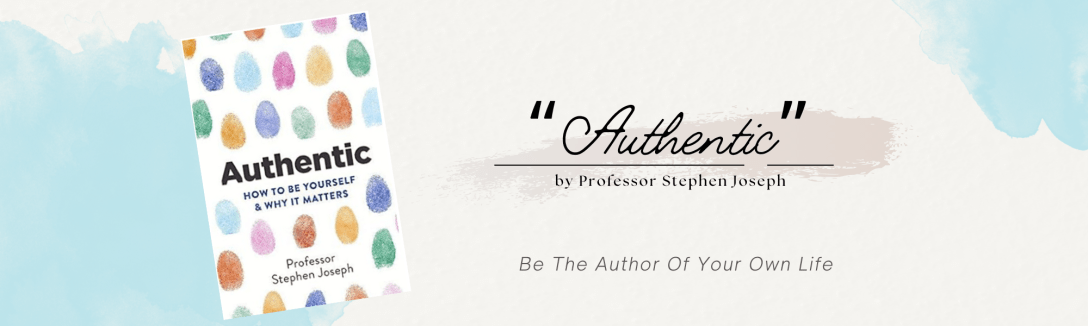
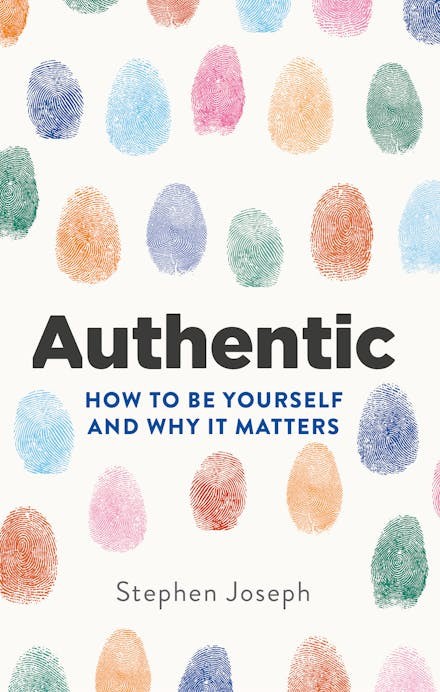
What Authentic is about?
Just as the title suggests, this book is about being your authentic self and why it is important.
In his book, Professor Stephen Joseph talks about different mechanisms that prevent us from being ourselves and offers some ideas and exercises that help to break free.
You should read this book if you are…
- A People Leader: By understanding yourself better, you will be able to establish your own path of being a good leader and inspire others to do the same.
- A Chief of Staff: As the right hand of the leader and often their proxy inside the organization, it is important to remain authentic. This way you can support the organization your leader is in charge of and support your leader in discovering the best choices while staying true to their authentic selves.
- A Human Being: Discovering yourself and staying true to it will help you to live a happy, fulfilled life full of good memories, not regrets. As Stephen Joseph demonstrates throughout his book, being an authentic person sets a good example for others around us, not just our partners, kids, friends, or coworkers but also for our institutions, governments, and society in general.
This book –
- Looks into what it truly means to be authentic
- Shows mechanisms that get in the way
- Offers exercises to find your true self
- Is based on dozens of research studies
- Contains many case studies based on real-life stories
- Focuses on the journey and gives hope.
But
- Is not very actionable (no 3-5-10 steps to become authentic)
- Could have been more practical
- Would benefit from more information on authenticity in the workplace
- Does not contain case studies to illustrate positive examples of people being themselves.
Authenticity is about being true to yourself in each and every moment.
Key Ideas
I. Formula of Authenticity
- Authenticity comes from Greek authentikos which means to ‘act in one’s own authority’. It consists of three powerful elements: knowing yourself, owning yourself, being yourself.
- To know yourself means to understand your needs, strengths, interests, likes, and dislikes; and to be aware of what is going on inside and outside of you. It’s about being honest and non-judgmental towards yourself and being able to listen to your own voice.
- To own yourself is about setting boundaries for yourself and respecting the boundaries of others, taking responsibility for our own life and letting others take responsibility for theirs. To stop offering unsolicited advice and solutions falls into this category.
- To be yourself is to “walk the talk” – to stand your ground for what you believe in, to be capable not only of acting but also to walk away.
II. Why authenticity matters
- A long time ago, Aristotle proposed the concept of eudaimonia: living by one’s daimon (spirit, character, virtue) leads to a good life.
- Much later (in the XX century), Abraham Maslow developed a pyramid (hierarchy) of needs on top of which he put self-actualization which he saw as our highest need and described as the ability to become everything that one is capable of becoming.
- If we want to be authentic, we need to find a way to live our lives matching our general propensity. That means, if we are authentic, we are actually living our lives in a way that leads us to fulfill our full potential.
- Depriving ourselves of the opportunity of being our true selves and suppressing our true emotions and desires requires a lot of mental energy and greatly affects our health, not to mention our joy of living.
- Authentic people, on the other hand, tend to be happier and healthier (both physically and mentally), more resilient and tolerant of uncertainty, more efficient, have better relationships with others, and are better adjusted in life.
III. How do we derail
- It starts with childhood when our picture of self is influenced by the people around us. From “boys don’t cry” and “you’re a girl – you need to be pretty” to “artists don’t make good money” and “if you smile all the time, nobody will take you seriously” – we learn all sorts of things about the world and ourselves. We are rarely encouraged to discover ourselves and learn who we are.
- At some point, we develop defense mechanisms that protect our ideas of self and the world around us. Those mechanisms protect us from anxiety and give us firm ground to stand on. At the same time, they distort our perception of reality and defend us from our true selves.
- “If we can transform our anxiety into enthusiasm to engage with the challenge and learn from it, we are on our way to authenticity”.
IV. Start with yourself
- Your ability to be an authentic parent and raise authentic kids is limited by your own authenticity. If you haven’t worked through your own conditions of worth and defense mechanisms, the chances are you will not be able to accept your children unconditionally for who they are or are inclined to become either.
- Authenticity is indispensable to becoming a good leader and manager. Inauthentic managers micromanage and create toxic workplaces often without even realizing what they are doing.
- Staying true to yourself can help to “heal” the space around you as you will lead by example regardless of your job or status level within your organization or community.
- Being authentic implies having power over your own life and this is the best vaccine against oppressive leaders and inauthentic authoritarian institutions who aim to trick you to gain control over your actions and beliefs.
The authentic person is not fearless but is willing to feel their fear to be authentic.
Useful Links
If you missed my deep-dive articles:
- Introducing “Authentic”: What will you regret in the end of your life?
- 3 Exercises to Deepen Your Authenticity
- Concluding “Authentic”: Heal The Space Around You
To continue exploring authenticity:
- Man’s Search for Meaning by Viktor E. Frankl
- Way of Being by Carl Rogers
- Simplicity Parenting by Kim John Payne and Lisa M. Ross
- To purchase Authentic on Amazon: https://a.co/d/fO62Ynq
Next week we will embark on a new journey – and not just any journey – it will be a SAFARI. The book is “Strategy Safari: A Guided Tour Through the Wilds of Strategic Management” by Henry Mintzberg, Bruce Ahlstrand, and Joseph Lampel. Trust me – you don’t want to miss it!
Discover more from Knowledge In Action
Subscribe to get the latest posts sent to your email.

 Knowledge In Action
[…] the last part of this quote sounds familiar, it’s because it echoes the ideas of the book Authentic I reviewed earlier in this […]
LikeLike
[…] by Prof. Stephen Joseph: my review and purchasing […]
LikeLike
[…] to find medicine that will work long term. This is why I strongly recommend Stephen Joseph’s Authentic, or works of Carl Rogers and Viktor E. Frankl, whose books provide a life changing therapy that can […]
LikeLike