

In the previous deep-dive article, we explored the prescriptive schools of strategy making (aka this-is-how-you-should-do-it schools).
With this article, we are diving into an exciting world of the descriptive schools (aka this-is-how-you-are-actually-doing-it schools).
The Entrepreneurial School: “Enter The Elephant’s Rider!”
If you recall my very first article on Strategy Safari, the authors compared strategy to an elephant which cannot be described by each of its parts taken separately.
Well, the first school of descriptive strategic thought introduces the strategist as an elephant rider.
The entrepreneurial school … focused the strategy formation process exclusively on the single leader, but it has also stressed the most innate of mental states and processes – intuition, judgment, wisdom, experience, insight.
If the very first school (the design school) saw the strategy formation as a creative process that [somehow] happens within the CEO’s head, the entrepreneurial school views strategy as perspective, unlocking the astounding category of strategic vision – “a guiding idea” constructed by the organizational leader.
(Professional elephant riders are called mahouts. The authors of Strategy Safari didn’t offer a visual illustration for the Entrepreneurial School Strategist so I accepted the challenge: below is a picture of a mahout lancer from the video game Age of Empires III fearlessly facing the challenges of the war competitive market.)

Strategic Thinking As “Seeing”
In this context, strategic thinking becomes strategic “seeing”, and Henry Mintzberg provides a great description of the “seeing” that a strategic thinker needs to perform:
- Seeing ahead AND behind (“because any good vision of the future has to be rooted in an understanding of the past.”)
- Seeing above AND below (while many people agree that strategic vision requires seeing a “big picture” (i.e. seeing above), Mintzberg claims that it also requires seeing below because “there is no big picture ready for the seeing; each strategist has to construct his or her own.”)
- Seeing beside and beyond (to apply creative thinking that challenges conventional wisdom and places it into context “beyond constructs of the future” – forecasts and such – to invent “a world that would not otherwise be.”).
- Seeing through (because “what is the use of doing all this seeing … if nothing gets done?”)

and remember your why.”
It is worth noting how Mintzberg treats such a well-known (and, frankly, overused) notion of the “big picture”.
It is as if strategists should take helicopters, to be able to see the “big picture,” to distinguish “the forest from the trees.” But can anyone really get the big picture just by seeing above? The forest looks like a rug from helicopter […] Forestry people who stay in helicopters don’t understand much more than strategists who stay in offices.
Thus,
Finding the diamond in the rough might be a better metaphor. Strategic thinkers have to find the gem of an idea that changes their organization. And that comes from a lot of hard and messy digging.
So, who does all this “hard and messy digging”?
Hawkers With Umbrellas And Mercurial Strategists
Strategy Safari looks into the “entrepreneurial personality” that constitutes a significant part of this school’s research. And as the authors point out, much of these writings aren’t very positive.
They depict “tough, pragmatic people” with the “strong needs for control, independence, and for achievement, a resentment of authority, and a tendency to accept moderate risks”. Those people aren’t gamblers, they are “calculators”. They move quickly once they spot an opportunity, unlike administrators (aka managers) who prefer to move slowly to take “evolutionary” actions, “with long duration”.
They are the hawkers with umbrellas who materialize from nowhere on Manhattan street corners at the first rumbles of thunder overhead.
Another researcher made an association with Mercury, the Roman god of commerce, who had a reputation as a crafty, deceiving, ingenious god respected for his resourcefulness, nimbleness, and ability to become “magically present” in the right place at the right time.

the first entrepreneur
(A sculpture by
Artus Quellinus, 17th century)
Hawkers or Mercurians, entrepreneurial personalities actively focus on new opportunities, not problems; they move in “bold strokes” when facing uncertainty, are strongly motivated by the need for achievement, and tend to concentrate the decision-making power in their own hands.
And They Have Vision, Of Course
As planning faltered, vision arose. […] Every self-respecting organization suddenly had to establish a vision, or, at least, something that seemed sufficiently strategic had to be labeled “the vision.”
According to Strategy Safari, true vision requires “deep knowledge of the subject at hand” with the best visionaries having profound knowledge of their industry, company, and craft.
Visionary leaders must also be good with words. Mastering metaphors gets others to see what they see.
Visionary leadership is style and strategy coupled together.
And thus, the weakness of it: by relying on one person for vision and strategy, an organization is placing itself “one heart attack away” from losing both.
Not to mention the burden that the idea of visionary leadership puts on both – the organization (for finding a suitable visionary leader every time the previous one fails) and the organizational leader (to generate vision as best and as fast as possible).
It is partly for this reason that Collins and Porras, in their popular book Built to Last, suggest that it is better to build a visionary organization than to rely on a leader with mere vision.
Overall, the entrepreneurial approach to strategy formation works best for startups, troubled organizations in need of a turnaround, and small organizations requiring “strong personalized leadership” – all of these categories provide the context in which entrepreneurial personalities appear to thrive the most and cause damage the least.
The Cognitive School: “Let’s interpret the reality we construct!”
As you might have noticed, the entrepreneurial school still didn’t give us an answer about how exactly a strategy is created within the mind of an individual (whether visionary or not).
And this is when the cognitive school enters the stage.
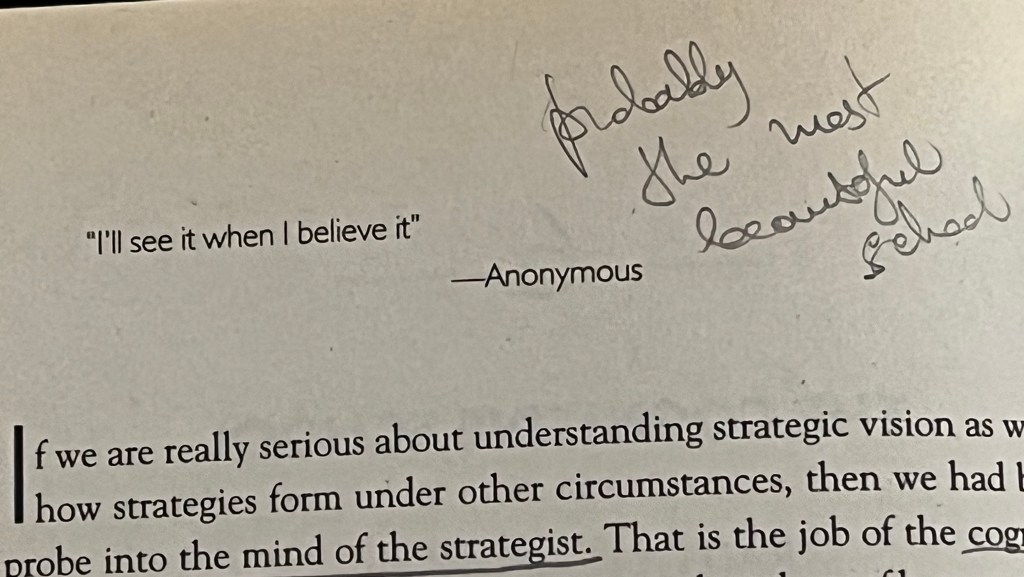
from my personal notes within Strategy Safari
The cognitive school looks into strategy formation as a mental (cognitive) process and draws on the research of cognitive psychology.
This is the most enticing school because it puts into perspective our own perspective:
- How are we perceiving the outside world?
- Are we perceiving it accurately?
- What is the outside world to begin with?
- Is it actually outside? Or is it just inside our minds?
Confused? You are not alone.
Confused Strategist or A World Builder?
There are 2 wings of the cognitive school: objective and subjective.
The objective wing looks into cognition (i.e. mental process in our brain responsible for how we process and assimilate knowledge) and says that cognition constantly attempts to create an objective picture of the world around us.
And constantly fails – because of all the biases and distortions that we have as human beings, leaving us confused and uncertain face-to-face with a complex reality beyond our full understanding and control.
Decision making thus becomes not so much rational as a vain effort to be rational.
The subjective wing turns it all on its head and questions our very ability to create an objective picture of the world claiming that “reality exists in our head”.
There is more to cognition than some kind of effort to mirror reality – to be out there with the best map of the market… For the interpretative or constructionist view, what is inside the human mind is not a reproduction of the external world… The mind, in other words, imposes some interpretation on the environment – it constructs the world.
So, on the one hand, we have a perpetually failing attempt to see the world as it is, and on the other hand, a never-ending construction of reality out of “rich and ambiguous information” by each individual separately and each organization as a whole.
Which hand do you prefer?
What if you cannot choose?
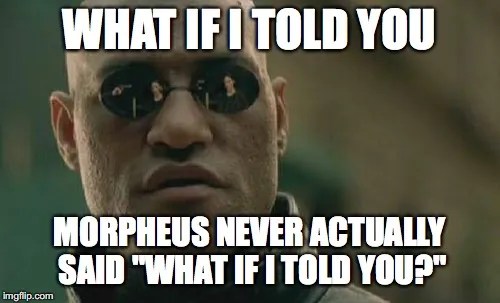
Just like Darth Vader doesn’t say “Luke, I’m your father”, Morpheus never says “What if I told you” in the Matrix movies. Yet so many people “remember” him saying it, “What if I told you” became one of the most known memes on the Internet.
For me, the beauty of the cognitive school consists in questioning and putting into perspective everything we thought we knew about the formal strategic process. It does the same thing Management of the Absurd does: it makes you see the “invisible obvious” that all of a sudden unquestionably makes sense.
Take, for instance, the SWOT analysis.
How does one know what is an opportunity and what is a threat?
Say, you are entering a new market (let’s take lingerie from my very first “consulting” experience) and you discover that your emerging customers don’t want the laced negligees you purchased in Paris but are actively requesting comfortable cotton bras in plus sizes.
Is this an opportunity or a threat?
One can argue that it’s an opportunity because as a new business you are very lucky to have any customers at all (and here they are doing marketing research for you by telling you directly what they want).
Others may say that those negligees were very pricey and the brand you are trying to create will suffer from attending to these particular customers.
In reality, it all depends on your actual strengths, weaknesses, and beliefs – what you are and aren’t capable of doing, what you are and aren’t ready for, what resources and knowledge you have, and overall – how you decide to interpret the incoming information.
All of a sudden, the very objective SWOT analysis becomes awfully subjective leaving you either more confused or proud, depending on how successful your decisions deriving from it proved to be in the future.

or a cab customer?
Photo by Craig Whitehead on Unsplash
Blurry Vision
To conclude the review of the entrepreneurial and cognitive schools would be best with the below quote from Strategy Safari taken from the cognitive school chapter:
And vision emerges as more than an instrument for guidance: it becomes the leader’s interpretation of the world made into a collective reality.
And it is worth remembering that according to the cognitive school, this vision can be blurred by different biases, personal and collective beliefs, and even conventional wisdom.
If our ability to interpret reality or construct the accurate picture of it in our brain affects so much our ability to make strategic decisions and gain strategic perspective, it is even so more important to educate ourselves as leaders and managers, challenge our assumptions, improve our capacity for self-reflection, encourage “multiple realities” around us – diverse teams offering diversity of thought, and continue to gain new knowledge and unlearn conventional wisdoms we thought were true.
All of a sudden, all those “soft”, and “buzz-wordy” characteristics of good leaders such as authenticity, self-reflection, ability to listen, diversity and inclusion cease to be abstract categories for viral LinkedIn posts and self-help books. Instead, they gain very practical meaning for the longevity of organizations and their long-term successes.
And isn’t this beautiful?
Next week, we will look into one of the most complex schools of strategic thought – the learning school. Consider subscribing to this blog so as not to miss it!
The title photo is by Paul Skorupskas on Unsplash
Discover more from Knowledge In Action
Subscribe to get the latest posts sent to your email.


[…] How Accurate Is Your “Big Picture”? […]
LikeLike