
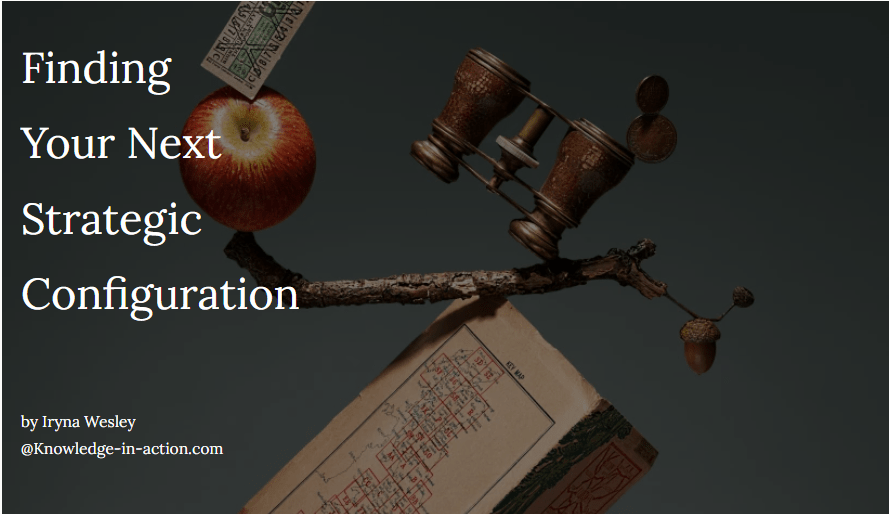
As we conclude our journey into Strategy Safari, the school of strategic thought that encompasses all of those we already saw – the configuration school of strategic management – greets us in all its glory and… simplicity.
In this article, we will explore this simplicity further.
How it embraces and makes sense of the competing ideas of other schools we’ve seen so far.
What makes it work so well to this day.
Why sometimes it might be too plausible to be useful.
Let’s dive in!
The Configuration School: Making Sense Of It All
So far we have seen 9 schools of strategic thought and you might have noticed that often their guiding principles would lay on the extreme opposites.
For instance, the learning school promotes constant experimentation and knowledge gaining to help the organization discover its best strategy. On the other end, the planning school vouches for the rigorous planning process where a strategic plan and its operational sub-plans don’t change much if at all once established.
The configuration school elegantly puts these disputes to rest using the following statement:
Each school at its own time, in its own place.
In other words, this school finds that the guiding principles and recipes of each school can serve as configuration models applicable within the relevant context.
If a biotech startup initially requires a strong strategic vision coming from a single leader that doesn’t need much formalization, a mature pharmaceutical company benefits from a well-articulated long-term strategic plan translated into thoroughly defined short-term objectives. Other configuration elements such as organizational structure, culture, stakeholder engagement, and competitive actions would look very different for both companies, even if they operate in the same market.

This brings us to the idea of organizational lifecycle.
See, a startup does not stay a startup forever. And a mature company doesn’t stay the same over time. Market changes and so do organizational capabilities, leaders, conflicts, and interests. The context shifts and suddenly an organization finds that the current configuration that served it so well for many years (or months) is no longer viable. A new configuration should be found and a transformation should occur.
Strategy making thus becomes shaking [entrenched behaviors] loose so that the organization can make the transition to a new state.
This introduces a new set of words that are so common nowadays in popular management literature and consulting services: change management, transformation office, turnaround, revolutionary approach, reconfiguration, etc.

Photo by Xavi Cabrera on Unsplash
Quantum Leap Into Strategic Transformation
The key to strategic management… is to sustain stability… most of the time, but periodically to recognize the need for transformation and be able to manage that disruptive process without destroying the organization.
According to the configuration school’s most prominent contributor, Danny Miller, organizations periodically undergo the so-called quantum change – meaning they change many elements at the same time.
“At the same time” is key here because many strategy gurus of the past claimed that strategy preceded structure, thus you had to come up with a good strategy first before you would move on to the next step.
Miller argued that while quantum change could occur gradually over time, it had to happen systematically and affect many major elements of the organization.
So when it comes to the learning organization (nodding to the learning school of strategy), when developing a new strategy and executing its quantum leap, this type of organization can leverage its own experience and rely on the emerging strategic patterns that have been already occurring in different departments / processes / systems.

So there has arisen a great deal of literature and consulting practice on massive programs of comprehensive change, namely transformation.
Strategy Safari was published in 1998 and since then there haven’t been any groundbreaking changes in the way we approach strategic management.
The only thing that truly changed was the pace of the change itself.
With the technology development in recent years and the global disruption caused by the COVID-19 pandemic, organizations of all configurations need to adapt to the new context faster and in a quantum way.
We see it happening in real time: companies across industries and geographies concurrently revise their structure (is it remote or hybrid or back to the office 100%?), their culture (is it 150% dedication to the cause or work-life balance in the trying times?), and their shareholder promise (is the artificial intelligence ready today for what it promises to deliver tomorrow?).
All these questions make the configuration approach to strategy ever more relevant today providing a relatively simple framework to navigate the ambiguous and unpredictable context we are all living in right now.
If you hear any “transformational” buzz-words I mentioned in this article from your leader, consultant, speaker, or book author, know that they are adhering to the configuration school of strategy – whether they realize it or not.
Too Simple For Its Own Good
But nothing is perfect, and the configuration school isn’t an exception.
The very things that make an organization excellent can breed subsequent failure.
The quantum change advocate Danny Miller also pointed out that simplicity can be a management downside. Making things “too simple for the manager” to understand and pass down may blind them to the nuances of the real-world situations in favor of plausible and easy-to-convey answers.
Or even make them take their strengths too far or rely on their competitive advantage too much.
For instance, an organization with a strong focus on innovation risks becoming a chaotic unit unnecessarily introducing new technologies without assessing the need or impact. Or a small team proud of its collaboration and non-linear reporting structure grows into a group with no proper communication channels where its right hand doesn’t know what the left hand is doing.

Another case against simplicity is its lack of nuance.
A model is always an approximation – the real world is full of complexities of different shape, color, and texture – the ability to distinguish one organization from another and build upon this distinction is what the management is about – whether we like it or not.
But because drowning in nuance does not help either –
Managers have to choose from among flawed theories.
The key here is to choose a configuration (or school of strategic thought) that fits your case while keeping an open mind about it.
One day this configuration might no longer fit or it might produce the results you did not expect – so you need to learn from experience and adjust.
And it is equally important to recognize when the current configuration is okay and the “revolutionary transformation” or re-configuration is not needed. Don’t let a recent HBR article or a newly hired consultant convince you otherwise just because the new configuration is more “trendy”. After all, it’s all about the nuance!
To paraphrase Lewis Carroll:
“Beware the Jabberwock simplicity and trendy solutions, my son!”
This concludes our deep-dive exploration of Strategy Safari: A Guided Tour Through the Wilds Of Strategic Management. I hope you enjoyed it as much as I did. As always, I will summarize the key ideas of the book in the “at-a-glance” review next week. And then, much in the spirit of summer and the well-deserved vacation break it usually brings, we will start a new journey – this time into the book Time Off: A Practical Guide to Building Your Rest Ethic and Finding Success written by John Fitch & Max Frenzel and illustrated by Mariya Suzuki.
See you next Monday!
Discover more from Knowledge In Action
Subscribe to get the latest posts sent to your email.

 Knowledge In Action
[…] Finding Your Next Strategic Configuration […]
LikeLike
[…] Strategy Safari concluded with the configuration school of strategy that highlighted the increasing appetite for transformation in modern organizations . According to this school, each organization goes through its lifecycle adapting to the new context and level of complexity, using different strategic and organizational configurations (More on this – here). […]
LikeLike