

It’s a summer morning.
The rays of the August sun wake you up before anyone else in your house. You open your eyes and remember that today is your day off.
You don’t have to be anywhere, you don’t have to do anything, and you are completely free of any obligation or concern.
Today is your day and you can do whatever you want.
You let this idea sink in. You let the joy and sweet languor fill your heart.
Everything is possible. Who knows what this new day brings?
You can’t wait to find out…
I don’t know about you, but the last time I felt this good about my days off more or less constantly I was still in high school and it was my summer vacation. Since then I did have rare glimpses of similar mornings but they were getting progressively rare.
And then I became a parent and they disappeared completely.
I purchased Time Off: A Practical Guide To Building Your Rest Ethic And Finding Success Without The Stress by John Fitch and Max Frenzel back in 2021. I hoped this book would teach me how to take time off so I could recharge and stay more productive.
But as a chronic time-off-avoider, I didn’t read this book until this very year when I was forced to take an abundance of time off due to being a subject (or, rather, an object) of a recent layoff.
So the timing was perfect but even then it took me a few months to get to it because I was so busy with all my side projects (like starting this blog, for example) to actually process my time off and approach it systemically.
But hey, better late than never, and I’m a big believer that everything happens when it should. So let me tell you about some things that I’ve learned and some things that I’ve experienced as I was going through Time Off.
Time Has Many Faces
Once upon a time, time wasn’t really time as we know it.
The ancient world didn’t perceive time as an arrow moving from the past through the present into the future. Before the time “became” linear, we used to see it as a big circle. Time existed either as a cycle of nature (you sowed when the Nile made the soil fertile, and you harvested when your crops were ready) and/or a cycle of history (like in Hindu cosmology, where time was seen as a series of repeating events that occurred in 4 types of cycles of different lengths).
Even today, we hear about different “seasons” of our lives (at least working women do): active career ladder climbing, retiring, family building, layoff recovering, becoming an executive – you name it.
Time Off introduces two more “faces” of time: Greek gods Chronos and Kairos.


- Chronos (not to confuse with the Zeus’s father Kronos who devoured his own children) is the god of the time that we know best: the measured time. We worship Chronos by scheduling and over-scheduling our days, leaving no minute to spare, and being constantly anxious about running out of time.
- Kairos, on the other hand, is the god of the fleeting moment, the “spirit of opportunity”. He has a long lock of hair on his forehead that you have to grab from the front. Aesop claimed that Kairos could be only grasped as he approached you. Once he had passed you, not even Zeus could bring him back to you.
If Chronos had a signature song, it would probably be Time by Pink Floyd.
Kairos, in his rebellious nature, would prefer Lose Yourself by Eminem.
According to Time Off, Kairos is about the quality of time. 1 hour spent with your favorite person and 1 hour spent with an Excel spreadsheet are two very different qualities of the same time slot.
When we take time off from obsessing about Chronos time, we can slow down and exercise our “what’s possible?” mindset. We have a chance to access a different way of experiencing time. Rather than focusing on its passing, we can concentrate on the density of every single moment.
Is It “Milk O’clock”?
We no longer live in ancient times and would call 9-1-1 if a half-naked guy with a long lock of hair started to run in our direction.
However, that doesn’t make the below statement less true.
Cows must be milked when they are ready, not when it’s “milk o’clock.”
And yet we keep treating our work, our creative projects, our vacations, our life goals, heck, ourselves as cows who must give milk when we tell them to. Sometimes around the clock even.
Because if we don’t, we might run out of time, look bad in front of our boss, look bad on social media, feel like a failure, not do enough, not be enough.. Or, because everyone else is doing it (although, no, they don’t) or because we might miss out on an opportunity, or because we need that bonus or a promotion, or because, because, because…
At some point, we lose sight of it all, stop noticing that we are running on an empty tank, and burn out.
Then we cannot produce any milk at all – no matter how much time we had or what time it is.
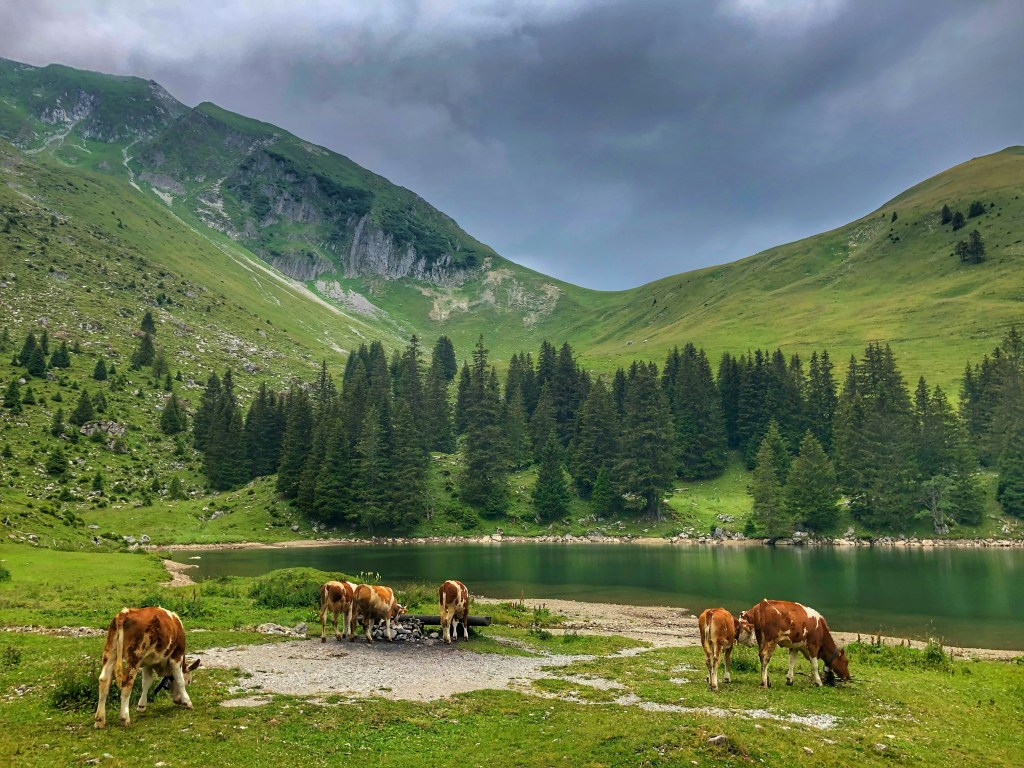
Photo by Keith @kiselstone
on Unsplash
We can’t keep inhaling forever.
And thus, we need to make time for the time off. We need rest ethic.
A great rest ethic… is about becoming conscious of how you spend your time, recognizing that busyness is often the opposite of productivity, admitting and respecting your need for downtime and detachment, establishing clear boundaries and saying “no” more often.. and ultimately finding and unlocking your deepest creative and human potential.
If the last part of this quote sounds familiar, it’s because it echoes the ideas of the book Authentic I reviewed earlier in this blog.
Looks like rest ethic and quality time off it entails allow us to discover and actively be our authentic selves.
So why aren’t we?
Moral Superiority of Hard Work
When the Industrial Revolution introduced paid hours, it transformed time into a resource that a worker would sell to an employer. This made wasting time at work a theft and spending very little time outside of work essentially a deregulated activity. Both of these matters were very concerning to the upper class society so the new teachings praising the virtuousness of work had appeared.
The authors of Time Off largely associate the modern cult of productivity and busyness with those (mostly Puritan) teachings: they condemned any type of leisure and proclaimed that “work alone was noble.”
Centuries later, at least here, in the United States, we continue to associate ourselves with our jobs, feel guilty and ashamed if we don’t have them (even when it’s not our fault), and work ourselves into burnout because it feels like a noble self-sacrifice in honor of a greater good (it’s not).
If we see work as a character-forming tool, then the more we hate work, the better. We feel dignity and self-worth because we hate our jobs. Busyness, stress, and overwork have become our modern form of divine self-sacrifice.
Do you hate your work yet?
Tough Love Of Noble Leisure
It wasn’t always this way.
One of the greatest Greek philosophers, Aristotle (384-322 BC), spoke highly of leisure seeing it as a noble activity that is done for “its own sake, in search of meaning rather than purpose.”

Noble leisure is not the same as rest or idleness (so feared by the industrial Puritans).
“On our modern interpretation, Noble Leisure reflects the free choice made by self-sufficient individuals to pursue what is most worthwhile.” – The Noble Leisure Project
Or, as Time Off puts it:
True leisure, noble leisure… is an activity in which we can find our greatest fulfillment as humans.
Did you know that the word “school” actually derives from the Latin scola and Greek skole which meant leisure?
Turns out, many years ago, school intended to prepare for a life of leisure and culture…
Indeed, an elegant weapon concept for a more civilized age.
Something that I found out as I started my personal time off journey is that this noble leisure requires tough love – and not just towards the leisure activity itself but towards ourselves.
We tend to think that finding time to discover what brings us joy and makes us fulfilled requires courage. And it is true – because to do so, we need to say “no” to many people and tasks that otherwise claim our attention.
But courage isn’t the only thing we need.
Looking for answers requires persistence and cannot happen just because we had one free hour last September and decided to ask ourselves what was the meaning of our lives.
I thought I would find all the answers for the next chapter of my life in 3 months I deliberately took off from the job search. I expected to be done with it and then move on with my life finding a new job and getting re-absorbed into the fast-paced business environment.
But it turned out that looking for answers is a never-ending process (obvious in retrospect, right?).
I keep finding more and more questions, and I now understand that I need to incorporate this search into my daily life, whether I am looking for a new job or working already.
This search for answers, acting on them, actively pursuing your goals, and making time for the activities that bring you fulfillment requires consistency.
It also requires being comfortable spending some time off with yourself and letting you discover who you actually are at your own pace and time.
It requires discipline.
It requires intent.

Immediate Next Steps
So what can you do right now to rediscover the guilt-free joy of noble leisure?
Here are some steps you can take:
- Plan out some time off: Plan 30 min of leisure time for this week (thankfully, it’s Monday!). Don’t just block 30 min on your calendar and forget about it until someone tries to claim this timeslot. Plan it out like you would a work task. What are you going to do? How are you going to do it? Will you be alone or will you be with someone else? Do you need to make any arrangements or bring anything with you?
- Take a No Chronos day: Pick a day and ditch the clock (if you can’t take an entire day, make it half a day. Set your Alexa to remind you about time existence at noon or put away your watch when you come home from work and don’t pick it up till you feel like you are ready to go to bed).
Take some notes about the non-measured time you spent.
What did you feel? What did you think? What did you do? - Tell Yourself “It’s not milk o’clock!” next time you feel stuck while making another slide deck or trying to come up with an idea for your project. If you are pushing yourself to make something creative but are feeling like a car spinning its wheels being stuck in mud, remind yourself that even cows don’t produce milk on demand, and take yourself on a walk around the block.
I once rescued a neighbor’s dog from the 90F heat because I felt stuck working on an article and went out for a short walk.
Who knows where you are truly needed right now? - This week, start asking yourself what brings you fulfillment outside of work.
Don’t think about it too hard. Just toss this thought around. Maybe you know your answer already. Maybe you have no idea. Whatever it is, it’s ok – just keep it in the back of your head.
We’ll talk more about it next week.
And next week we will take a deep dive into our creativity and discover how rest, sleep, exercise, and solitude can enrich it and allow for the fulfilling and rewarding time off that “Aristotle would have been proud of.” Make sure to come back next Monday!
The title photo is by Stephen Wheeler on Unsplash
Discover more from Knowledge In Action
Subscribe to get the latest posts sent to your email.

 Knowledge In Action
[…] Are You Living Like It’s “Milk O’clock”? […]
LikeLike