

Progress is not only reflected in the peaks you reach – it’s also visible in the valleys you cross. Resilience is a form of growth.”
This article is a deep dive into what Adam Grant in his Hidden Potential calls “structures for motivation” – a “scaffolding” system that will help you to get unstuck and keep going when bringing your hidden potential to life.
What Is Scaffolding?
Adam outlines 4 major characteristics of scaffolding:
- It typically comes from other people (i.e. usually in the form of advice, mentorship, or role modeling).
In his Management of the Absurd, Richard Farson quotes E.B. White: “Luck is not something you can mention in the presence of self-made men.” The same goes for the help of others.
Being self-made is so highly regarded in some cultures (the American one, in particular) that we are often ashamed to ask for help perceiving it as a sign of weakness.
But it cannot be further from the truth – it takes real courage to admit that we need help; it requires us to face our difficulties up front without pretending that everything is fine as it is. Reaching for help leads to humility, gratitude, and a sense of belonging that is hardly achieved by all those who are determined to remain isolated.
Moreover – it can help to unlock your hidden potential by seeking guidance from those who know you or the path or both. - Scaffolding depends on the specific obstacle you must overcome.
- You need it “at a pivotal point in time.”
If your project is failing or you are stuck in your career, you need that scaffolding right now and not next year. It needs to be in the right place at the right time. - It is temporary.
Good news for the “self-made men” out there: you don’t need your scaffolding structure forever.
Once you get through that pivotal moment where you might need some additional help, you are done and can manage further on your own.

Scaffolding unleashes hidden potential by helping us forge paths we couldn’t otherwise see.”
So let’s take a closer look.
Finding Harmonious Passion With Deliberate Play
Harmonious passion is taking joy in a process rather than feeling pressure to achieve an outcome.”
The challenge is to find this harmonious passion in the most tedious tasks.
Sure, taking piano lessons because you finally have time to pursue your dream and impress your friends with the Pirate of the Caribbean theme song can easily keep you glued to your instrument for hours a day (provided you actually do have time). But how do you deal with hours and hours going through terms and documents to prepare for your certification?
We’re often told that if we want to develop our skills, we need to push ourselves through long hours of monotonous practice. But the best way to unlock hidden potential… is to transform the daily grind into a source of daily joy.”
So how do we do it?
Turns out, it helps to introduce deliberate play in our activity making the development of a particular skill or acquisition of particular knowledge enjoyable.
Deliberate play often involves introducing novelty and variety into practice.”

You can introduce deliberate play in the way you organize your learning process, your goals, and your tools.
Adam Grant says that usually the deliberate play scaffolding comes from a teacher or coach, but you can create one for yourself too. Challenge yourself on how quickly you can complete a task, see how many answers on a quiz you can get right the first time, or go for a swim once a week instead of running every morning – bring joy to the routine.
Another somewhat unconventional practice to break the routine and to learn is to make your routine tasks/exercises intentional.
I learned this from my yoga instructor back in Ukraine. As we were doing some basic warm-up exercises, she kept telling us that we should always make even the most routine movements as if this was our first time making them.
This is one of the best methods to stay present in the moment, find joy in it, and keep learning even when what you do can seem repetitive and dull.
I am not sure if Adam Grant read Time Off or if it’s the great-minds-think-alike phenomenon, but some of his ideas outlined in the chapter Transforming the Daily Grind echo the importance of deliberate play and regular breaks from Time Off (here is my deep dive if you missed it: link).
Play is not a frivolous activity – it’s a source of joy and a path to mastery.”

Getting Unstuck
Progress rarely happens in a straight line; it typically unfolds in loops.”
It’s a peculiar phenomenon: on the one hand, we love stories about those who persevered despite all the hurdles and throwbacks of life – on the other, we expect our own stories to develop more linearly. “Study well, go to college, get a good job – and your future will be secure,” we tell our kids.
Maybe if we look back at our life it looks like a straight line but a quick zoom-in would show us quite a lot of loops and hoops.
And sometimes before we find a new path forward, we need to retreat.
When we reach a dead end, to move forward, we may have to head back down the mountain.”

on Unsplash
If asking for help is difficult, backing up or starting over feels even worse.
As an emigrant, I had to restart my career twice in two different countries, and I assure you it is not a pleasant feeling. In retrospect, it all made sense and helped me develop skills, gain experience, and pave the professional path that I wouldn’t have been able to imagine if I were to execute my career path linearly. But in the moment… Boy, it was hard.
So how can we prepare ourselves?
According to Hidden Potential, the first thing to do is to embrace the discomfort of getting lost. And second – to get some navigation tools.
We won’t have a map – too often we are the first ones on the road and need to pave our own way. But we can have a compass – to ensure that we are heading in the right direction.
This compass can be a book, an article, a useful podcast that you heard on your way home, or even a useful conversation with your friend or coworker.
And on your journey, don’t rely on just one guide.
If you collect directions from multiple guides, they can sometimes combine to reveal routes you didn’t see.”
Nobody knows the best route to reach your destination (even your mom despite her strong belief in the opposite). Some guides don’t know you well enough, others don’t quite understand your destination; those who are there already might have forgotten important details of their journey or they might be convinced that there is only one way to reach that destination and if you haven’t started 10 years ago, you are a dead cause.
But they all might have some useful elements for your journey. That’s why I love Adam’s metaphor of dropping pins – this is what your guides could do for you: share their knowledge, advice they took or rejected, changes they made, and skills they gained.
One of the best advice I got this year was to start approaching my career as wall climbing: sometimes you need to make a lateral move or go down a bit. It’s all about the skills you gain to move forward.

Photo by Nathan Cima on Unsplash
Teach And Coach
When the odds are against us, focusing beyond ourselves is what launches us off the ground.”
Hidden Potential illustrates this point with the incredible story of the Golden Thirteen – the first Black men commissioned and warrant officers in the U.S. Navy.
In the highly prejudiced world of the U.S. Navy where black men had not been allowed to even try to enter the officer training, where the instructors were blatantly racist, and the whole system was designed to make this “experiment” fail, the first class of black officer candidates – all sixteen of them – aced their final exams. And not only did they succeed once, they had to retake some of the exams twice (because the higher-ups got suspicious), and the second time they scored even higher with a collective GPA of 3.89 out of 4.0.
Of course, this story goes way beyond a single chapter in a self-development book, but there are a few lessons that Hidden Potential outlines for the rest of us:
- Trust “credible believers” and prove your “ignorant naysayers” wrong.
Credible believers are often our teachers or mentors. They are credible sources because they have knowledge and expertise, they can see in us what we don’t see in ourselves yet, and they believe in us even when we don’t.
But ignorant naysayers do not know us, they lack knowledge and expertise – and we can prove them wrong. Treat them as fuel to ignite your inner confidence, the dry piece of wood that you can use to ignite the spark within yourself. - Teach if you want to learn.
This is known in psychology as the tutor effect – “the best way to learn something is to teach it.”
This is one of the reasons I started this blog actually. I wanted to share the great ideas I was finding in all these books I’ve read or intended to read. I thought if I could explain and connect them, I would remember them better and others could learn from them too.
It turned out that I was using the tutor effect. - If you need confidence, coach.
Adam calls it “the coach effect” although he admits it is not a scientific term.
Coaching others to overcome obstacles helps with our own motivation and self-confidence. It also “raises our expectations of ourselves.”
In my experience, it also makes you feel a bit more useful – yes, I am still stuck on this project or haven’t succeeded in this domain but at least I helped out a friend today, this counts as something worth living for.
In the Navy training environment known for its cut-throat mentality, first black officer candidates looked out for each other. They gathered after dark to study as a group, they motivated each other, kept each other on track, and managed to succeed despite all the ignorant naysayers who worked hard to have them fail.
And not only did they look for each other – they paved the way for the future generations, all black men who now had the opportunity to enter the officer ranks, and defy the odds.
This is a single story that makes Hidden Potential worth reading!
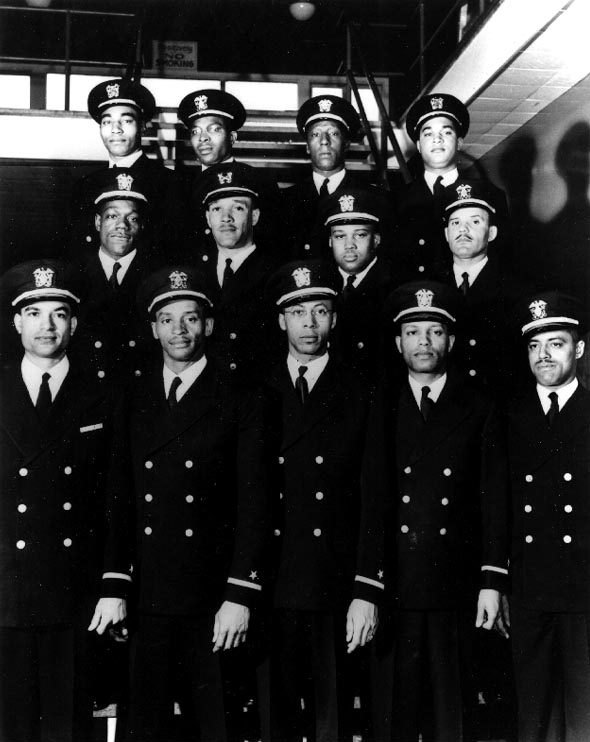
The Golden Thirteen (March, 1944) –
https://en.wikipedia.org/wiki/Golden_Thirteen
In Conclusion
It is both unreasonable and unhelpful to expect reaching our heights all on our own.
There are moments when we need special scaffolding – a temporary help that will support us when we get stuck – either in our routines or on our life journey.
So transform your daily grind with deliberate play, find your compass, ask your guides to drop some pins, teach to learn, coach others to regain inner strength, and only listen to naysayers if they help to ignite your spark.
So, are you ready to cross that valley?
Next week we will conclude our deep dives into Hidden Potential with an overview of systems we can build to open the doors to those with hidden potential. See you next Monday!
The title photo is by Patrick Hendry on Unsplash
Discover more from Knowledge In Action
Subscribe to get the latest posts sent to your email.

 Knowledge In Action
[…] Are You Ready To Cross The Valley? […]
LikeLike